Thursday, February 13, 2020

Subtle Beauty

Common polypody (Polypodium virginianum)
I have been feeling we've been marooned here in the cold northeast. I am a planner and goal-setter, but this winter I have been learning how to relinquish the control I normally exert and let the universe dictate. I've been reluctant to say the least, wracking my brain for a work-around because quite simply, this wasn't the way I planned it. I'm usually of the school of thought that if one wills it hard enough, one can make it be. But, I am beginning to think otherwise, at least if one wants to respect the delicacy with which life deserves to be handled. To put it simply, we were first stalled in our plans to head south for the winter by a delayed house-closing. This seemed a really big deal, that is until we got hit with bigger news. My fifteen year-old feline, Fran, has cancer, a cancer that cannot be treated. This lil' girl has been with me since I was 21 years old. She adapted to tiny apartments, wild fields and craggy mountains, even life in a 24-foot trailer. She awaited my return from every long hike I have taken. She could tell stories. So with Fran presently residing somewhere between earth and the ethereal, we are remaining here and taking one day at a time. And I have been ambling and trail running...a lot. Best therapy I know.

Amos at an Appalachian Trail register
As I have allowed myself to be here, really here, there is a beauty I have witnessed. I have been graced with a gift, the gift of time and quietude, and the opportunity to uncover and form connection with the subtle beauty that surrounds me. So Amos and I took a hike the other day on the Appalachian Trail - a trail that always feels like home - in Stokes State Forest - a forest I've explored more times than I can count. Still, I was enchanted by what we found.

Overlooking Culver's Lake from Kittatinny Ridge on AT
We began our hike at Culver's Gap off of Route 206 and hiked south on the AT, in the opposite direction of Sunrise Mountain, which is where most visitors gravitate. Within twenty minutes we stood on the Kittatinny Ridge overlooking Culver's Lake. Accompanied by pitch pine and cedar, we took in the views and then walked the rocky spine of the ridge and soon followed the white blazes into the forest. The trail was rocky, rockier than I remember and so I had to watch my every step.  But, beneath the towering oaks, beech and black birch, is where the real magic was found.

Foliose lichen on rock. Gray-green is thallus and mud-brown is ascomata. Both part of the same lichen, that I believe to be of genus Xanthoparmelia
The trail undulated and rocks that jutted like vertebrae from a spine were splotched in lichen, gray-green and mud brown, that in the subdued winter landscape appeared more vivid than ever. In the absence of flowering plants, I have been paying more attention to lichen lately, wanting to know their forms and names. They grow, slowly but surely, in the most unfavorable of conditions and their growth is so slow that we rarely take the time to notice it. 

The lichen pictured here, likely Xanthoparmelia, is considered a foliose lichen because of it foliage-like form. The gray-green lichen body, or thallus, adheres to the rock face but possesses leafy lobes that only loosely adhere. The mud-brown structure beside it is actually part of the same foliose lichen and contains the reproductive structures, called the ascomata. The ascomata are cup-shaped discs that contain spores. Lichen are an organism that is formed from the mutually beneficial relationship between an algae and a fungus. They readily reproduce assexually vegetatively, but when it comes to acquiring new genetic material, the fungus partner, disperses spores on the wind, just as any fungus would. Those spores hope to find a suitable algae somewhere out in the forest and create new lichen. Pictured is also another slow process at work. This lichen is microscopically decomposing this rock, a imperceptibly long process of converting stone into fertile soil. This category of lichen that grows on rocks - saxicolous - are different from the epiphytic lichen like old man's beard (Usnea) which grows on tree bark and twigs without affecting the tree.


Rock Tripe (Umbilicaria)
Another lichen, rock tripe, called the largest of boulders home. Rock tripe (Umbilicaria), true to its foliose form, resembles decaying leaves. This one is edible, however I would not recommend harvesting it unless in an emergency situation. Lichens grow slow, so consider how long this rock tripe has been forming here and how long it will take it to regenerate after you've picked it. Plus, it's flavor is reportedly nothing to be desired and can only be consumed after much boiling.

Trailing arbutus (Epigaea repens)
But it wasn't just the lichen that were persisting here in this wintery forest as flurries periodically burst forth from the sky. In mossy tufts along the trailside I found copious amounts of trailing arbutus (Epigaea repens). The evergreen leaves of this member of the Heath family can be steeped in hot water for an astringent tea rich in arbutin. Arbutin - also found in cranberries - prevents the adherence of bacteria to the urinary tract lining. Therefore sip this tea to prevent or relieve a urinary tract infection. Trailing arbutus shared its space with fellow medicinal family member wintergreen (Gaultheria procumbens). Wintergreen's leaves contain methyl-salicylic acid, which acts as an analgesic and anti-inflammatory, and boasts a bright red minty-tasting berry.

Mountain pool
About three miles in, the trail led us downhill into the belly of the forest and we came upon an icy pool, likely formed by a depression and drainage. However the rocks, blanketed in lichen and moss, made for a perfect seat while I enjoyed some trail mix and Amos, some chicken strips. After pawing at the ice, Amos was pleased to discover he could get some cold mountain water from here too. I imagine this pool is home to peepers in the spring as well as many a mosquito. This was the perfect time to appreciate it.

Headed south on AT along Kittatinny Ridge
 After winding uphill, following the sloping contour of the mountain, we emerged at another high knob on the ridge, similar to the first but far more expansive. At this moment, I had the thought I could be on the balds of North Carolina or Virginia. I could be anywhere. I was, in an instant, transported but at the same time, so very present, so very here, on this beautiful mountain top. Blonde grasses spread out like a blanket and gray rocks lined our path, as we approached three pitch pines straight ahead. To our right, the view just kept on going as the wind gusted and the clouds rolled away.

AT on Kittatinny Ridge - notice the white blazes

AT on Kittatinny Ridge when the sun appeared

AT on Kittatinny Ridge, clouds casting shadows
Speaking of pitch pine (Pinus rigida), it too was in the process of some slow growth. Squat cones with sharp scales hung from its resinous twigs. Cones take two years to mature and spread seed and these were still hanging on, closed tight, waiting for their time. Needles from pitch pine, like white pine (Pinus strobus), contain vitamin C and convey anti-microbial and expectorant properties, when infused in hot water. True to pitch pine form, these needles not only sprung from twig tips and branches, sprayed from the trunk of the tree.

Pitch pine cone (Pinus rigida)
From where we stood, we weren't too far from the summit of Rattlesnake Mountain, but with dusk soon approaching on this winter's day, it was time to turn back. We had roughly 4 miles to go before we would return to the parking area.

Amos looking down the trail
Amos was moving fast, eager for home as he followed the scent of the tracks we had laid. But still, I periodically slowed our speedy return to admire more lichen and the few plants we found growing in the thin dirt atop large boulders and beneath the shelter of towering trees.

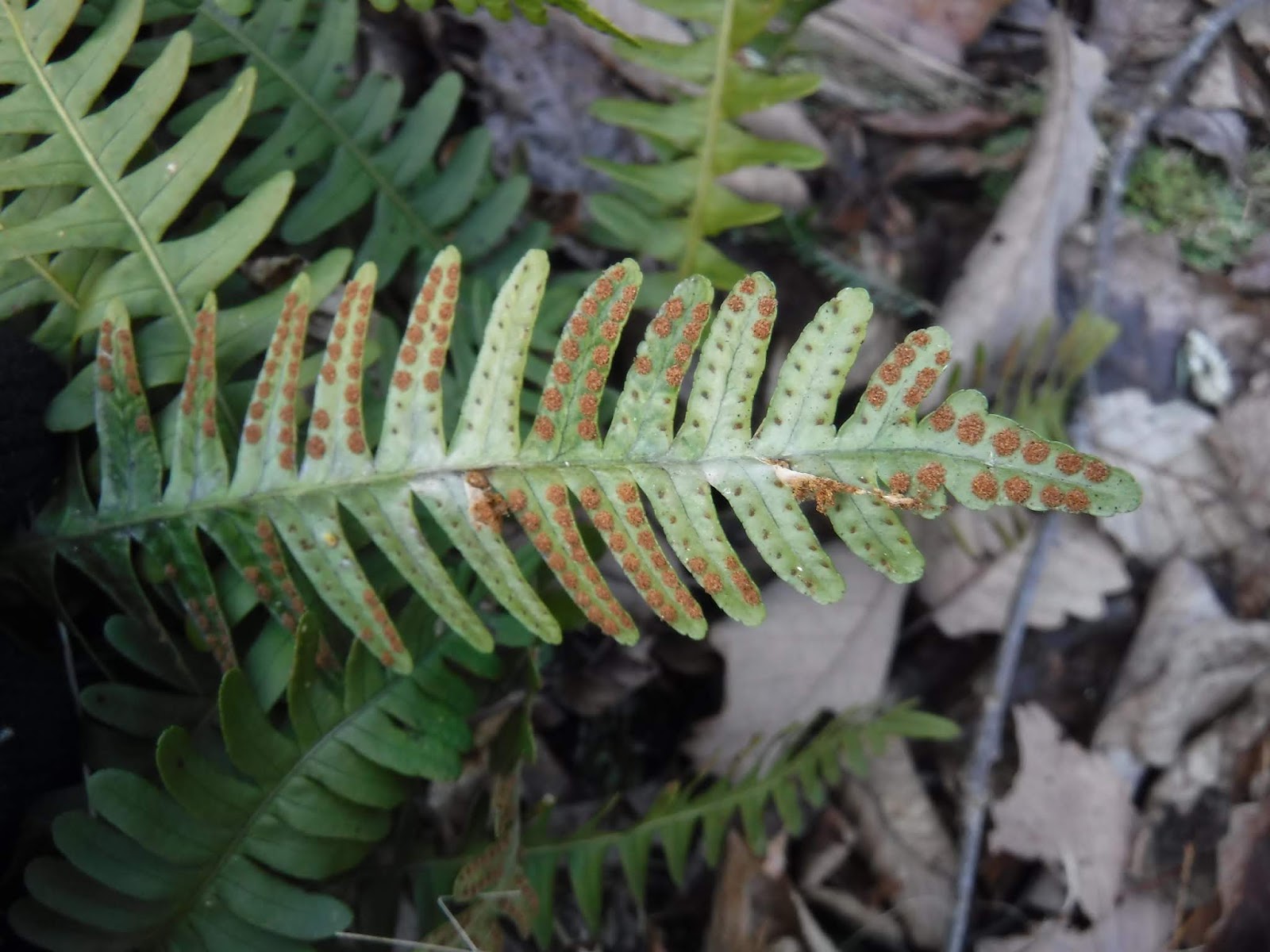
Common polypody (Polypodium virginianum)
Common polypody fern (Polypodium virginianum) grew in green sprays, providing an offering of green life. Notice the opposite lobes of this fern are not truly opposite but somewhat asymmetrical, which is typical of this fern. Flipping over a frond, I found rusty colored sori, which hold the dust-sized spores called sporangia. Spores are normally released in autumn and carried by the wind or unwittingly, on the fur of a passing critter. Considering our season, the spores of this fern were probably long dispersed, but it was a pleasure to see its orderly arrangement nonetheless.

Hickory nuts (Carya)
Decaying hickory nuts and further down the trail, acorns sometimes rolled under our feet like marbles and this coupled with the rocky trail, resulted in a couple of spills. I am certain Amos tugging the way home had something to do with this. But to tell you the truth, sometimes making sudden contact with the very solid earth - a jolting thud! - can be strangely satisfying. A reminder of our earthly bodies when we are all up in our heads. Did I mention hickory nuts are related to the pecan and quite tasty when in season. Acorns too. But these were long overdue.

Overlook on Kittatinny Ridge, just south of Culver's Gap
Before I knew it, we were back to the overlook above Culver's Lake and it was all downhill from here. I heard a red-tailed hawk cry out and gazed overhead to see his silhouette cruising the breeze. I watched him until I could see him no more and he called out again. The late day sun now shone bright and with all the miles we'd hiked, we were toasty warm despite temps in the thirties. My muscles ached a bit - I guess I'm not 25 years old hiking the AT anymore - and even Amos had slowed his pace. But it was a good kind of ache and my spirits were brighter. Sometimes we need a reminder of the slow growth that is always at work and subtle beauty of which we too are a part.

I started writing this post before our cherished Frannie passed away. She died on February 12, 2020, about five days after this hike on the Kittatinny Ridge. Our last days with her were indeed a gift of subtle beauty and on our parts, reluctant slow growth. We are better for it and so thankful to have been here with her until the end. Her journey and our own now continue...
Sunday, January 5, 2020

Due South!

On the Florida Trail in Osceola National Forest

So I have kind of been feeling like this lately - shin-deep in molasses-like mud. All the while wishing that I really was shin-deep in gritty, pollen-drenched, belching mud somewhere in a Florida swamp. Instead my love and I have been playing the waiting game here in the Northeast, impatiently biding our time until the Universe says "Okay, GO!" Our plan was to hit the road, southbound, the day after Christmas. But as we all know - plans shmans! Sometimes circumstances arise that prevent us from following our perfectly laid plans such as a delayed house closing, an ailing beloved feline, or a hitch for our truck that got lost in the ethers. As a thru-hiker I accept this fact. I know that with every itinerary I draft, circumstances out of my control will cause shifts and ripples. But that is where the adventure takes shape. 

So although I have been feeling as if we are stuck, kind of like stuck in a trail town waiting for a maildrop that was supposed to arrive yesterday, I think its high time I embrace the stuck-ness.  We are in the unknown and really is that so bad? So rather than waiting to post an update until I know just what is happening, I decided I would simply outline some of the major elements we plan to incorporate in our adventure this winter.

   
Our tiny home for the winter - Rockwood A192 Hard-wall Pop-up Camper

We will be returning to the sunny climes of Florida. However we thought after exploring the length of the state by foot last year, we would cut ourselves a little break. We will be mobile in our tiny home, a gem of a find on Facebook Marketplace, this pop-up hard-wall camper. I have always dreamed of a little A-frame cottage in the woods to call my own but what's even better than that? One on wheels. We will be hauling this beaut with our elderly pick-up truck - hey what says adventure more than a Dodge sporting 208,000 miles and counting? And no home is complete without an animal companion.

Amos Moses

Amos Moses, our beloved coonhound, a rescue inspired by a pup that stole our hearts on the Florida Trail last year, will be in tow. As you can see, he's been in training for Florida, with alligator chew-toys and all. We know Amos has a whole slew of adventures in store for us that we cannot foresee. Does anyone else see a potential book in the writing, say, Amos and an A-Frame? We have couple of primary objectives for returning to Florida this year. Firstly, the hiker community.

Billy Goat Day 2019
On our 2019 thru-hike we were supported by so many incredible individuals connected to the Florida Trail, from members of the Alliance, Association, to locals we met along the way. Our hike would not have succeeded had it not been for these folks. Therefore, we want to give back. We hope to make it to Florida in time for Billy Goat Day, an annual gathering in honor of the legendary Billy Goat himself, and the Florida Trail. This is our one definite pinpoint for our travels while in the state. Other than this one-day event, we plan to travel Florida with a watchful eye for this year's thru-hikers. We know all too well just what a cold beverage or a ride into town can mean to a weary hiker. We want to be of service. We also look forward to reconnecting with all of you who became friends on our journey.

Lantana

Scott on Florida Trail north of Kissimmee Prairie Preserve

And as anyone who has thru-hiked knows, one of  the downsides is not always being able to linger in a magical place as long as you'd like. Therefore we hope to revisit some of those special places we discovered on the Florida Trail as well as experience some pieces we did not have the opportunity to hike, such as the western route north of Kissimmee. I plan in our hiking excursions and nightly camping spots to better study the botanical inhabitants. On our thru-hike we succeeded in a broad survey of the plants of the trail, however we would like to obtain a better working knowledge with the edible and medicinal plants and broaden our identification skills. Florida is after all, the land of the flowers, and we have only scratched the surface.

Some of our dear friends in Asheville - Noah, Alex and Addy - in the Shining Rock Wilderness

In addition to Florida, we will be making our annual pilgrimage to Asheville, NC, where we will play in the mountains with our dear friends. As most of you know, Asheville was my home for a good portion of my adult-life. No matter the time that has passed, when I hit Blue Ridge trail, connecting with that clay-compacted soil sparkling with mica and woven with tree roots, my heart remembers my kinship with this place and when I am in the company of loved ones that remain ever close no matter the distance, I am reminded that this too, is my home. We will of course, be reveling in the Appalachian plants while we are here as well, familiar botanical beauties that were among the first I could ever name.

This year has been a full one with some major accomplishments for both of us. Since thru-hiking the Florida Trail, I have a finished manuscript about our hike on the Long Path. Scott has completed two new albums, one of which I am on, my studio debut! So, in the meantime, maybe I will start the next book and Scott will craft the next album. May as well put this quiet time hanging out in town to use! But while doing so, we will continue to pack up our belongings for the road and dream of what's to come. And for now, that's what I can tell you. I don't know when we're leaving or when we'll be where - a first for me - but that's the general non-plan and really all part of the adventure. One thing, I can promise you...even if we end up in my tiny Volvo with a hound, a tent, and a couple of backpacks, we will be due south! 

Bot, Wise Man, and Amos looking forward to seeing y'all soon!


Thursday, October 24, 2019

Fall into Foraging

Sassafras (Sassafras albidum)
Here in the northeast, our forests and roadsides are awash with color. The plant world is pulling out all the stops, a showy display of ripening hues, before finally dulling, decaying and falling into Winter slumber. Autumn is in every sense, a time of transition and for us, a time of inner work, of contemplation, and ultimately release. We may sometimes forget our connection to the natural world, somehow viewing ourselves as separate from it, because let's face it, we've done a pretty good job of distancing ourselves from it. However, during this time of year, when we are hit smack in the face with nature's beauty, beauty which is born from flux, we can choose to either go about business or take a moment to connect, deepen that relationship with nature and in turn, ourselves.

Autumn strolling


For me, foraging is a means to do just that. To forage I must not only step outside and take a walk, but I must slow down and observe my surroundings. I need to take note of just what sort of plant community I have wandered into, the interplay between the plants, the soil, the sun, and water source. Recognizing these elements helps me to know just what plants I might see or tells me that I need to take a side trail to reach the particular plants that I seek. Although Autumn is a raucous color show - we have to think outside the box of greens and flowers - when considering our plants useful for food and medicine.

White Pine (Pinus strobus)
Our Pines, those trees in the Pinus genus, that we may pass daily without much regard are our most important cold weather herbal allies. Steep the needles in hot water for an infusion that is firstly antiseptic, making it excellent internally or externally for fighting infections. Compound this action with the fact that needles are also Vitamin C rich - a healthful boost to the immune system - decongestant and expectorant - perfect for quelling the symptoms of a sinus infection or cold. Needles are lastly, diuretic and diaphoretic, therefore cleansing to the body. Any of our true Pines may be used for medicine, with White Pine (Pinus strobus) being one of the safest because it is effective yet gentle.

Wintergreen (Gaultheria procumbens) in plum-color for Autumn
Then there are evergreens that are not always so obvious. These may lie hidden beneath the copious  needles of a White Pine or the leaf litter of Birches and Oaks, often they are sheltered by twiggy wild Blueberry shrubs. Behold the usually humble Wintergreen, aka Teaberry, scientific name Gaultheria procumbens. It is a member of the Heath family with absolutely no relation to Mint although its common name, aroma, and flavor would suggest otherwise. Although it is evergreen, select plants in Autumn or Winter will turn a reddish or deep plum color. 

Wintergreen (Gaultheria procumbens) - typical coloring
Wintergreen leaves may be steeped in hot water for a minty beverage, fully equipped to reduce muscular aches and pains. The berries, which appear in Autumn are also edible and provide the perfect trailside nibble. Collect enough and use an adornment your atop holiday cakes or in baked goods.
Staghorn Sumac (Rhus typhina) fruiting cone
Speaking of fruits, Sumac is rich in them! Well, kinda sorta. Sumac's fruits may be more aptly described as seeds covered in an acidic coating. Staghorn Sumac's (Rhus typhina) fruits are fuzzy as is its branches, reminiscent of a young buck in velvet. Smooth Sumac's (Rhus glabra) fruits are, as its name suggests, smooth. Both may be used interchangeably. Clip a fruiting cone at the base and submerge in cold water for several hours. Water will turn a rusty hue. 

Sumac fruiting cone in mason jar of cold water - Sumac infusion in the making
Remove cone, strain liquid through cheesecloth to catch fine hairs and any little critters that may have made home therein. Then add honey and sip to your health. Like Pine needle tea, Sumac infusion is rich in Vitamin C. 

Burdock burrs (Arctium)
Let's not forget those roots. Digging these will also warm bones on a brisk Fall day - trust me. Many folks know Burdock by its Velcro-like burrs. Although plants with these burrs will be too mature from which to harvest roots, they are a good indicator that smaller first year plants may be nearby. Look for large leaves with fuzzy undersides. Then pick up your shovel.

Burdock roots (Arctium)
It is unlikely you'll manage to pull up the whole taproot which can reach over a foot in length, but you should manage to ease at least a portion from our rocky soil's grips. Burdock root has a long history of use as both an adaptogen and an alterative. It is a nourishing food - edible as a root vegetable - as well as medicine -  pleasant as a tea. This time of year, the roots contain a fiber called inulin. Inulin acts like a pre-biotic, literally feeding your pro-biotics, or healthy gut flora. Give your flora what they need to flourish and guarantee yourself not only stable digestive tract but a strong immune system. 
Sassafras (Sassafras albidum)
While on topic of roots, let's take another look at that first photo, Sassafras (Sassafras albidum). The creamy white roots of Sassafras saplings - please only harvest these rather than from a mature tree - are intoxicatingly fragrant and provide one of the most delicious and warming teas around. Clean, peel, and dice roots, then simmer in hot water for 20 minutes and strain. Your beverage will taste of earth and spice and lemon, will increase heat in the body and cleanse the blood. I think of Sassasfras as a medicine for supporting the body's own methods detoxification and preventing illness.

There are so many more we can discover! Please join me for an Edible and Medicinal Plant Walk, a seminar on Seasonal Foraging or Hiking Essentials, or a Wild Medicinal Tea tasting at The Lodge at Woodloch, located in Hawley, PA. As their Certified Herbalist, I offer an array of activities weekly, centered around getting outside and connecting you with the plants. For dates and times, please see: https://www.thelodgeatwoodloch.com/activities/ 


Saturday, September 28, 2019

Autumn 2019 Herbal Activities


We are in the season of the gnarly roots, the crunchy seeds, the tart berries, when the Witch Hazel leaves fade to yellow and the acorns roll beneath your feet. Autumn. This  season always summons contemplation for me and perhaps that makes sense. The quietude of Winter is on the horizon and it is as if the plant kingdom is giving its last hurrah, a show of color and bounty before a deep sleep. Autumn is a time of transition and one that shouldn't be missed! Get outside, take hike, identify the dainty Asters, crush the Spice Bush leaves, and take some time to be in it.

Scott and I are excited to visit with trail friends both new and old at the Appalachian Long Distance Hikers Association in Massachusetts in October and to share in the story-telling. As always, I have classes from tea-making to backpacking 101 at the Lodge at Woodloch. And as Hike Local, we are always happy to customize your next upcoming family hike, botanizing adventure, or group event! 
Take a look below to see our scheduled group activities!

Appalachian Long Distance Hiker's Association Gathering
Williamstown, Massachusetts
October 12 - 14th
This event is not to be missed! The ALDHA Gathering is an annual event in which hikers from all over the country convene to talk trail, share their experiences, and get inspired for their next journey. We will be offering two presentations over the weekend: Edible and Medicinal Plants for the Backpacker on Saturday 10/13 afternoon and A Botanical Hike on the Florida Trail on Sunday 10/14 afternoon. My two edible and medicinal plant guides will also be available for purchase at the Hiker Fair. 
Cost: $20 per person for weekend attendance (meals not included)
camping on the grounds is provided


Plant Walks, Herbal Workshops, Long-distance Hiking Seminars 
The Lodge at Woodloch, Hawley PA
Wednesdays, Saturdays, Sundays throughout the season
As Woodloch's Certified Herbalist, I offer an array of activities centered around our natural world and holistic health. Book your stay and check out their outdoor activity schedule for a list of dates/times at: 

Book your activity with Hike Local
PA/NJ/NY
Do you have a group that would like to learn more about the edible and medicinal plants through a guided hike on a local trail? Perhaps you and your family would like to take a walk on your own property to learn about your very own plants? Do you have a group that has varying degrees of endurance? We also offer slideshows and workshops. Contact us and allow us to tailor a hike or activity specifically suited to you and your group!
Contact us at: HikeLocal@gmail.com
Visit: www.Facebook.com/HikeLocal to learn more

Happy Harvesting!