Tuesday, June 7, 2011

Nettles!

*this post is about two days behind. I have just arrived in the town of Linville and will be taking 2 days off in Asheville to take care of some household needs. Soon to be posted- overview of this this section as well as more plant and fun pics!

The Linville Gorge has proved to be a true butt kicker. However, a butt kicker with magnificent views from Shortoff Mtn, the Chimneys, and Table Rock. But as I watched the hawks soaring through the valley below me I wondered, why wasn't I born with a pair of those feathery wings? I suppose it's a good thing I wasn't, I might look a bit strange.

The first couple of days consisted of winding around the the mountains on wide old sandy jeep roads and I marveled at how the moist soil I'd been treading upon for the last 170m quickly turned to pure red clay and then sand and rock. The vegetation changed along with it. Gone went all of my moist cool forest loving plant friends, such as Black Cohosh, Trillium, Violets, and Foam flower, suddenly replaced by Pitch Pine, Bristly locust, Goat's Rue, and Sand Myrtle. Besides the persisting mountain laurel and rhododendron, I wondered, “Where have I traveled to”, and then, “I guess I'm not in Asheville anymore.” The next couple of days were filled with steep ups and downs, the steepest yet, through fire scorched sandy woods in the blazing hot sun, with many of the creeks and springs dried up, however it was here that I was rewarded with the massive splendor of the gorge and its rocky walls, as well as my first swimming- the Linville River with sandy beach and chair and all. More cold mountain waterholes were soon to follow.

And finally, as of today, just when I thought I'd never see a wild edible green again, I have climbed out of the gorge and descended back into my wet thick deciduous woods, with running creeks and rain and clean cold swimming holes. I have never been so happy for such abundant water. I have been fantasizing about frosty bottles of Aquafina and cans of Coca-cola for the last two days- so badly that when I'd gaze upon a town in the valley or glance at a plane overhead, my first thought was, “I wonder what those people are drinking right now?” And the trail, well, if you ever plan to hike the MST, or at least this portion, though it's absolutely worth it, bring a map! No, you know what, I have a map, and that didn't even prevent me from wandering down some other trail or ending up bushwhacking through thick rhododendron at least once daily. Just remember this, “If you doubt that you're on the trail, check your map, check your guide, double back, check your watch, look for blazes anywhere you could possibly think to look – up, down, horizontal- and then just start walking and hope for the best.”

It's been an adventure, Linville, a beautiful, at times exasperating, adventure.

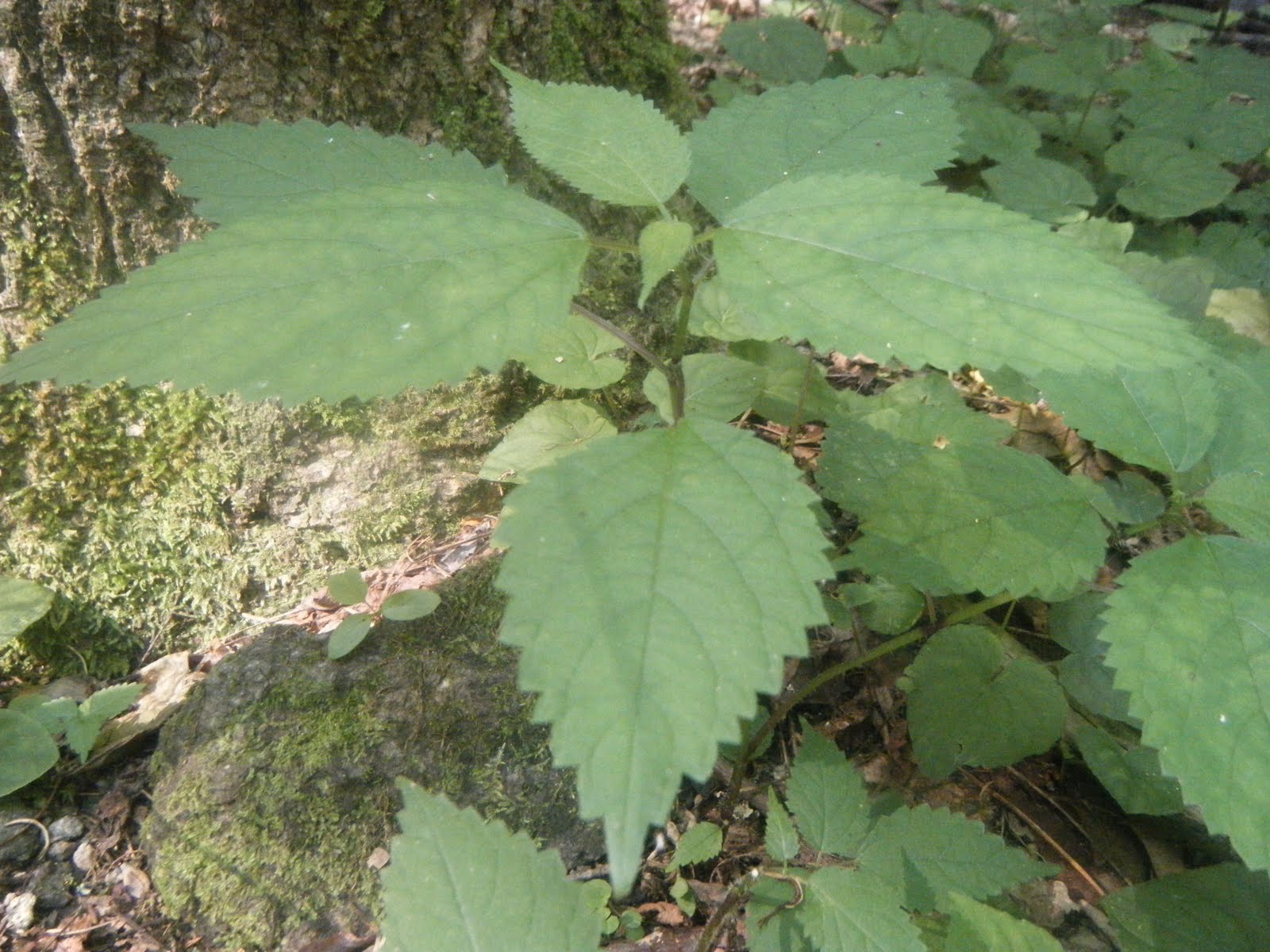
So speaking of wild edible greens I thought I might never see again. The first edible greenie back on the scene was Wood Nettle (Laportea canadensis). Oh, yes Wood Nettle, goes good in a pot, goes good rolled in ball, goes good when stinging bare legs to take your mind off sore feet. Wood Nettle is edible, however not medicinal, at least not in the same sense as Stinging Nettle (Urtica dioica). They are both considered true nettles and share the same family (Urticaceae or the Nettle Family), but not the same genus. Also, botanically speaking, they have some striking differences.

Wood nettle is the only true nettle with alternate leaves. Urtica dioica has opposite leaves, as does another nettle closely related called Slender Nettle (Urtica procera). So if you see a plant with stinging hairs and alternate leaves, this will already clue you in to the likelihood of Wood Nettle. 
Wood Nettle (Laportea canadensis) alternate leaves and purplish nodes (although I've have seen wood nettle without the very purple nodes

  
And although both Nettles have toothed margins (outer leaf edges), pointed apexes (leaf tips) and a somewhat wrinkled appearance, the base of Wood Nettle's leaves are round, whereas Urtica dioica's are heart-shaped.


Wood Nettle leaves with round base, toothed margin, and pointed apex

Stinging Nettle (Urtica dioica) leaves with  heart shaped base
Thirdly, we certainly cannot forget the stinging hairs of Wood Nettle, though Stinging Nettle bears the very word in its common name and in my opinion packs a more brutal sting, Wood Nettle still stings, possessing fine hollow hairs that act like needles. These are found on the stem, leaf stems, and leaves. When an unnoticing hiker brushes past, fluid at the base of each hair pressed is injected into the skin, releasing histamine, formic acid, and neurotransmitters such as serotonin. Now, whether our body actually processes say serotonin as serotonin, or breaks it down into something else, is unknown. However, I will say, as I breezed down the trail, getting brushed from this side and that, like a car through a carwash, afterwards, I felt quite alert and well, "charged UP!" The sting can leave a sort of itchy, shivery, sensation, but does not last all that long. It also seems as if different communities offer different degrees of sting. I have encountered Wood Nettle in which I've had to do all I can to receive a sting, and others where it took just a single touch.


Stinging hairs of Wood Nettle


 Lastly, when in flower, Wood Nettle will display both female flowers in the axils and male flowers terminally, whereas Stinging Nettle has male and female flowers on separate plants, hence the name Urtica "dioica" which means "2 houses" or in this case, "2 plants." The greenish female flowers will hang in loose clusters from the axils, whereas the male will reside in, more upright, at the top of the plant. Wood Nettle nor Stinging Nettle will not flower until Summer.

Wood Nettle is an incredibly nutritious food, high in vitamins A and C, magnesium, potassium, iron, and calcium. I also found it too be quite tasty. If grabbed with confidence and rolled up into a sort of tube, you must likely will not get stinged, one can also grasp a bit more carefully and roll up the leaf to the stem where you can pluck it off easily, also without getting stung. This does not always work, but I have found it does 99% of the time. I harvested some as I was hiking from this amazing patch you'll see below, and saved in a ziploc for that night's dinner. I added them to a pot of mac and cheese, letting them boil with the noodles and they came out quite nicely, a light taste and an easy addition. If you like to nibble while you hike you can also grab the leaves, rolled them up into tight balls and just pop them in your mouth. I did this as well and didn't get stung once. However, I recommend the smaller leaves for this, as the larger ones are more fibrous and better reserved for cooking.

Was some hungry hiker requesting greens? This patch as well as another large patch hugged both sides of the trail for about 0.2m

Wednesday, June 1, 2011

Hiker's Wound Wort

Mount Mitchell already under the belt and now I am celebrating in the little holler of Busick with a pint of Ben and Jerry's. Thank you to Viola and Don, and Mr.Effler himself of Effler's Grocery for letting me plug in my multitude of electronic items and using your lovely countertop back in the corner as my personal "wifi" cafe. This wonderful little store supplied me with all of the instant meals and snacks I'll need, as well as a pack of dental floss, for the next 6 days.

It was a challenging climb up to the top, but the views at Mitchell were fantastic and luckily I arrived after Memorial Day weekend. I hung out at the top and enjoyed the museum and concession stand- quite the set up for a mountain top - and then hiked back down through miles of evergreen forest with little more than Yellow Clintonia, bluets, and blackberries, finally coming back down into the lowlands of blooming fuschia rhododendron, white and pink mountain laurel, and all of my well-known plant friends, such as halberd violet, common cinquefoil, and flowering galax. Down in the gap, I passed through Black Mountain Campground, and thanks to Gloria and Al, enjoyed a shower (oh my, how a shower will make you feel like a brand new person, even if you put the same dirty clothes on) and a chocolate dipped ice cream cone, as well as some much needed good conversation while lounging about in folding chairs on the front porch.
a view from atop Mt Mitchell (6,684ft)

But if there was any adventure to the last couple of days, besides climbing the highest mountain east of the Mississippi, it was my puncture wound, thanks to a Hawthorne tree. When I went to get my bearhang down yesterday morning, I managed to get it snagged up on some branches and so thought, "oh, well I'll just grab this large stick down here, and knock it down!" Still in my sleepy state, I failed to really look at the stick I grabbed, and as I swung it up into the air, impaled the fat of my hand with a hawthorne spine. For those of you who aren't familiar with Hawthorne, it is a tree in the Rose family that bears sharp spines all along it's branches. These are so sharp that Native Americans used to use them as fishing hooks. This injury wouldn't have been so troublesome if the darn thing hadn't broken it's tip off in my hand.

Hawthorne (Crataegus sp.) spine...now Hawthorne berries are also an excellent heart medicine, so I will at some point have to do a post of its positive attributes.

So still without breakfast, I went to work on trying to work it out - no luck. I hiked on throughout the day as my hand grew more swollen and red and sore, wondering how the heck I was going to take care of this really rather minor, but at the same time, very real predictament. I collected some resin from a spruce tree remembering what I'd learned from 7Song. Applying hot resin to a stubborn splinter somehow changes the balance of pressure below the surface of the skin and actually will draw it out. Resin is also anti-bacterial to boot. However, I wasn't sure if this method actually applied to a "splinter" of this size. I used some hand sanitizer to keep it clean and then applied some yarrow oil, not only to disinfect, but to try and keep the inflammation at bay as well. It seemed to help some, at least taking the red out.

Yarrow (Achillea millefolium) flowers. Notice, this is a plant in the Asteraceae family (Daisy family). The inflorescence (flowerhead) is composed of many little flowers, each made up of disk and ray florets.

And this brings me to the plant of the hike (!) I did eventually work the splinter out, using that handy sharp knife again and cutting away a bit of skin to make for some wiggle room, and then honestly, using my mouth and just sucking with all my might, until I pulled it up just a bit above the surface of skin, until I could pull it out with a pair of tweezers. A good 1/3" that thing was! It was another shining moment. Afterwards I walked over to the meadow not far from my camp, grabbed some yarrow leaves, chewed them up and spit them on. Anti-inflammatory, anti-bacterial, and astringent, along with some enzyme rich saliva, how can you go wrong?
spit poultice

I haven't talked much about my foot pain, as I haven't wan't to dwell on the matter, but now that it seems to be getting swiftly better, I feel it important to share with y'all what's been most helpful for me. I was experiencing pain around the achilles tendon area, a sort of dull ache when I wore shoes and stepped off, the heel of my shoe hitting my achilles. Besides getting new shoes, I iced for the first few days (probably a day longer than necessary), took 600mg ibuprofen 3x/day, and then for the next 3 days, cut back the ibuprofen to 600mg 2x/day and started on warming to bring increase blood flow, moving out the inflammatory chemicals and help to bring in the repairing ones. I made a yarrow oil, by warming about 4oz of safflower oil on low on the stove, and then gathering some fresh yarrow, threw a handful of chopped leaves and flowers in the mix, letting the mixture combine for about an hour. Then poured the whole mixture into a plastic container to take on the trail with me. For about 3 days leading up to my leaving, I massaged this into my achilles tendon 3-5x a day for about 5-10 minutes at a time. This honestly seemed to be the time I saw some real results. I also used Traumeel homeopathic gel 3x day, and then switched for a couple of days to Capzaicin cream. However, once hiking, this cream created a burning sensation (too much heat along with the compression socks) and so now I am back to the Traumeel and still using the yarrow oil 3x/day, along with some light stretching in the morning and evening (a few very mindful downward dogs, about 10 breaths each).

Ironically the scientific name for Yarrow, also known as Soldier's Wound Wort, is Achillea millefolium. Achillea refers to Achilles who is said to have used it with his soldiers in the Battle of Troy. It has a long history of being regarded as a herb for protection. Millefolium is latin for "many leaves", referring to it's fern like alternate leaves. The plant is stoloniferous, meaning that it sends out new plants along its roots that run horizontally underground. So, if you find a only a single flowering plant, take a look around and you will most likely see lots of single yarrow leaves poking up as well and prime for picking. Be careful not to confuse this plant with Queen Anne's Lace or a random fern. But really once you take a good look at Yarrow, there's nothing else that truely resembles it. Another hint- take a good whiff of the flowers or crush a leaf or even better chew one up (these are edible in moderate amounts) and you won't forget its pleasant but strong fragrance.
Yarrow - notice the fern like alternate leaves (will post an up close shot of leaves soon)
In summary, I have thus far used Yarrow on my achilles tendon, my puncture wound, as well as some sore gums I was suffereing a few days ago (I chewed up a fresh leaf and let it sit against the sore spot, while also swishing with the saliva it encouraged). I don't know if I believe in "plant allies", but if they do exist, I believe I have found mine. Thank you Achillea Millefolium, from here on out I dub you Hiker's Wound Wort.

Sunday, May 29, 2011

Sedum and Sun

I am currently camped on a soft bed of tall grass just off the Douglas Falls trail (which runs along with the MST for about a mile). The sun is just beginning to set and some tweedly little bird is sing-singing. Man, when it's good, it's good. I'll have to remember that next time I drenched to the bone with too many miles ahead of me. Yes, the weather has been warm and sunny and I can hardly believe it, the bugs are out- black flies, gnats, and a few squeeters - but with the cool breeze that's been consistently blowing, none too bad yet.

Today was a bountiful plant day, as I passed through deciduous woods from Ox Creek Gap Road, up to Rattlesnake Lodge, on to high elevation grassy trail around Wolfden Knob and Lane Pinnacle, into the craggy beech and hawthorne woods of the Craggy Gardens area and back into the grassy woods here around Douglas Falls. Lots of new faces too: Sundrops, Pale Corydalis, and Virginia Waterleaf's purple flowers. But, to steal the show, a most unsuspecting little succulent: Wild Stonecrop (Sedum ternatum).

Before I get started, I'd like to give a little "word from our sponsor", and some due appreciation to Johnathan Poston. Johnathan joined me yesterday as I hiked out of town to learn a little about the plants and my hike thus far. He will be offering an article on the Mountain Xpress website/blog about my walk on the MST. Johnathan is affiliated with Jus' Running which was so kind to offer me some Clif Bars, blistercare pads, and a nice pair of quick-dry running socks. A link to this blog as well as some info about the hike will also be found on their website. And I'll be sure to let y'all know as soon as I do when that'll be up there.

...and back to Stonecrop. This is a very small plant, only about 3-8", but often appearing smaller because it creeps along the surface upon which it's growing. It seems to require little soil and can be found along rocks at the base of trees, along the edges of trail, and anywhere it's shaded and somewhat damp and cool. However, this little plant also has the ability to dessicate and just keep on goin', rehydrating once it rains. The lower leaves are in whorls of 3. The flowers have 4-5 white petals and grow in a 3-branched terminal cluster (Newcomb).


Wild Stonecrop (Sedum ternatum) - one community


The same plant, but a different community. As you can see, these look a bit different, the leaves more slender and angular, but still whorled in grouping of 3. In the lower right hand corner, you can see the white flowers. 

Notice, some of these flowers have 4 petals, some 5, green sepals, and stamens are rather conspicuous.
I have found this wild edible to be one of the very tastiest yet. I have never tried cooking it up, so I don't know how it would do, but why mess with a plant that is so delcious raw? It is crisp and fresh tasting and does well as a trailside nibble or as part of a gourmet backpacker's lunch... 

Wild Stonecrop with avocado, chedder, sunflower seeds, and a dash of pepper on a whole-wheat wrap
Yes indeed, that lunch rocked my world today. Tomorrow I'll be hiking on, criss-crossing the parkway, and then the next day, onto Mount Mitchell!  

Saturday, May 28, 2011

Some Updates/Corrections

Me, my backpack, the trail - one hour from now! But first some quick updates/corrections...

This is Fringed Phacelia (Phacelia fimbriata), not Miami Mist (Phacelia purshii) which is less deeply fringed and has lavender-blue petals.


Trillium vaseyi aka Sweet Wake Robin or Vasey's Trillium (previously labeled "unknown Trillium"). Newcombs has been my primary ID book, but this one, along with P.fimbriata are not listed. Evidence of our unique mountain niches.


Check out that flower!


Indian Paintbrush (Castilleja coccinea) is indeed edible. Native Americans used to consume the flowers as a condiment with wild greens (Wiki). This plant is rather uncommon around here and so, if you do taste, taste in moderation.

See y'all on the trail!

Thursday, May 26, 2011

Some fun stuff

Well, Asheville, it's been grand! But time to hit the trail. I'm leaving tomorrow afternoon or Saturday afternoon. My achilles is feeling much better, but I want to make sure I'm in tip-top shape before the upcoming Mt.Mitchell, Grandfather Mtn District, and Linville Gorge. Below I've included some fun pics, but first off I want to say my thank-yous and give props.

Thank you so much Rachel and Jodi for having me as a permanent fixture on the couch for the last so many days, feeding me ice cream, handing me beers, and aiding me in my all around blissful lounge time here in Asheville. Also, thank you to Amanda and Claire for giving me my own room for the night along with the most amazing 3(!) bowls of groundnut stew. And to all my friends there in Asheville who kept my mind off my aching tendon and kept me laughing.

Props to Diamond Brand for rockin' my world with a new pair of shoes, custom-fit insoles, and old lady compression socks. I was stressed and full of a hundred questions and you guys took your time and knew what you were talking about. Excellent service. I've also gotten my backpack from here along with many other random items and always been happy. Thank you, Jennifer Pharr Davis for suggesting I go back to them for my shoes. It was a thrill to run into you- what inspiration!

Now for the pics!

A snake I helped cross the road - I told him, "the Blue Ridge Parkway is no place for sunbathing"

This stern man stood guard at the entrance to the Soco Gap gas-up. There was even a sign on the window beside him that said "Protected by 357 Magnum." I didn't catch  his name but clearly not a fellow to mess around with

Wild Boar Track
Sampling the local foods: Catbrier (Smilax rotundifolia), Chedder, and ketchup wrap ( ketchup courtesy of a nearby Sonic)


Common Blue Violet (Viola soriora) flowers and leaves make a tasty and nutritious addition to a Lipton's Pasta Side


Evergreen woods en route to Silvermine Bald- can you spot the MST white blazes on the trees?
Thank goodness my steps aren't this tiny
the views looked like this for a good couple of days

But then the sun returned


The lovely ladies who came out and brought me good laughs, good food, a warm sleeping bag, and shouldered my pack
Rachel, Jodi, Michelle, Dogs:Harvey and Smokey

These fine folks, section hiking the MST, serenaded me with the song, "Happy Trails", just a few miles into Asheville- what a welcoming!
(Singing Sister, Timber Doodle, and Mr.Blister)


Lookin' forward to my feet looking like this again real soon...


Wednesday, May 25, 2011

Overview: Clingman's Dome to Folk Art Center (135m)

So for those interested in hiking the trail either in entirety or by section in the future, I thought it might be helpful to see the mileage I did, as well as where I camped, along with some short descriptions of each section, both terrain and plantwise.  (E) refers to edible, (M) for medicinal, and (E/M) means the plant is both edible and medicinal. I have been creating a plant list for each day, making note of what plants I identify and which ones are in abundance. However, these are so lengthy (1-2pages), that I think it may be a bit much for this blog. If anyone is interested in a particular section, I'd be happy to personally email that section's list to you. I apologize to any readers who are not so interested in all the specifics!

Day 1: Clingmans Dome-Poke Patch Campsite (8m)
Terrain- Evergreen forest with various lycopodium and mosses
Plants - Carolina and Eastern Hemlock(E/M), Red Spruce(M), Fraser Fir(M)), Hobble Bush, Creeping Bluets(E), Carolina Spring Beauty(E), Mayapple(E), Trout Lily(E)
Terrain - Grassy deciduous woods
Plants -(Black Cherry (E/M), Yellow Birch (M), Hobble Bush, Rhododendron, Maples, Oaks (E), Blackberry (E/M), Trillium (M), Toothwort (E), Phacelia, Meadow Rue, Indian Cucumber (E), Dutchman's Breeches, Galax (M), Cinquefoil (M), Squaw Root (E), Wild Blue Phlox, Canadian Violet (E/M), Wild Geranium (M), Sassafras (E/M)
Points of Interest: Deep Creek, wild boar, nice open campsite in a gap with bear cables

Day 2: Poke Patch Campsite - Newtown Bald Campsite (11m)
Terrain: Streamside
Plants: Dog Hobble, Rhododendrons, Mountain Laurel, Blueberry (E/M), Sweet Wake Robin Trillilum (M), White Clintonia (E), Lettuce Saxifrage (E), Indian Cuke (E), Foam Flower (M), Rattlesnake Weed (M)
Terrain: Deciduous woods
Plants: Maple, Oak (E), Tulip Tree, Black Locust (E), Pedicularis (M)
Terrain: Mixed Woods
Plants: White Pine (E/M), rhododendrons, blueberry (E), various Buttercups, various fleabanes
Points of Interest: Talkative friendly birds, Deep Creek, Pole Creek, and a challenging climb

Day 3: Newtown Bald - Barnett Knob (14m)
Terrain: Deciduous Woods
Plants: Maples, White Ash, Oaks (E), Sourwood (E), Pink Lady's Slipper (M), Smilax (E), Blueberry (E/M)
Terrain: Blue Ridge Parkway
Plants: Fire Pink, Common Plantain (E/M), Common Fleabane (M), English Plantain (E/M), Lyre-leaf Sage (M)
Terrain: Barnett Tower, grassy knob, gravel side road
Plants: Monarda (M), False Solomon's Seal (E), Solomon's Seal (E/M)
Points of Interest: high mountain trail, Blue Ridge Parkway, Observation Tower with awesome views

Day 4: Barnett Knob - Fork Ridge Overlook (14m)
Terrain: Gravel Road
Plants: Indian Paintbrush (E), Pedicularis (M), Purple Dead Nettles (E), Cleavers (E/M), Chickweed (E/M)
Terrain: Incomplete, non-maintained, wooded trail off parkway
Plants: Marsh Blue Violet (E/M), Northern White Violet (E/M), Umbrella Plant, Lettuce Saxifrage (E)
Terrain: Blue Ridge Parkway
Plants: Red Spruce (M), Hemlock (E/M), Fraser Fir (M), Rhododendron
Points of Interest: lush but difficult off-road hike, Water Rock Knob, views off parkway

Day 5: Fork Ridge Overlook - Moonshine Creek Campground (6.5m)
Terrain: Woods trail and gravel road
Plants: Wild Hydrangea (M), Wood Nettle (E), Putty Root, Basswood (E/M)
Points of Interest: campground, easy walking

Day 6: Moonshine Creek Campground - Double Top Mountain Overlook (10m)
Terrain: Unlevel trail (sloping downhill), gradual climbs
Plants: Dutchman's Pipe, Black Cohosh (M), Wild Ginger (E)
Terrain: Craggy, rocky, mountain trail
Plants: Yellow Birch (M), Beech (M), Usnea (M), Toothwort (M)
Terrain: Blue Ridge Parkway Overlook
Plants: Monarda (M), Virginia Waterleaf (E), Common Blue Violet (E/M)
Points of Interest: Views, challenging rocky/overgrown trail, Blue Ridge Parkway

Day 7: Double Top Mtn Overlk- campsite near Bear Pen Gap (14m)
Terrain: Craggy mountain forest
Plants: Hawthorne (E/M), rue anemone, black cohosh (M/E)
Terrain: Dirt road, grassy carriage road
Plants: healthy carolina hemlocks(E/M), oaks (E), monarda (M), blue cohosh (M), blackberries (M)
Points of Interest: wide easy trail, fields, mountain climb, poorly marked intersections

Day 8: Bear Pen Gap campsite - Graveyard Fields campsite (15m)
Terrain: Evergreen forest with lycopodium, moss and lichen
Plants: Hemlock (E/M), Yellow Birch (M), Bluets (E)
Terrain: Grassy Bald
Plants: Blackberry (E/M), Blueberry (E/M)
Points of Interest: gorgeous views, tough climbs, quiet woods, Silvermine bald, rhodendron grove

Day 9: Graveyard Fields - campsite near Pisgah Inn (10m)
Terrain: Rhododendron thickets, waterfalls
Plants: Blueberry(E/M)
Terrain: Grassy wooded hills between Blue Ridge Parkway road crossings
Plants: Pedicularis(M), Painted Trillium(M), Solomon's Seal (E/M), Turk's Cap Lily, Indian Cuke(E), Basswood(E/M), Spicebush(E)
Points of Interest: waterfalls, Skinny Dip Falls, boulders, views of Looking Glass

Day 10: Pisgah Inn campsite - Chestnut Cove Overlook (15m)
Terrain: Deciduous woods between Blue Ridge Parkway road crossings
Plants: Black Locust (E), Spiderwort (E), Showy Skullcap, Milkweed, Bloodroot(M), Rattlesnake Weed (M), Yellow Stargrass (M), Water Willow, Wild Yam (M), Marsh Blue Violet(E/M), Canadian Violet (E/M), Common Blue Violet (E/M), False Indigo, Pedicularis (M)
Points of Interest: easy varied hiking, abundant wildlife: turkeys, snakes, birds, bear, bugs, lowest elevation thus far (2100ft)

Day 11: Chestnut Cove Overlk - Folk Art Center (18m)
Terrain: Deciduous woods with Mountain Laurel and Rhododendron 
Plants: Stoneroot (M), False Goats Beard, Smilax (E/M), Showy Skullcap
Terrain: Grassy wide trail
Plants: Blackberry (E/M), Thimbleberry (E), Spicebush (E), Wild Onion (E)
Terrain: Pine forest
Plants: White Pine (E/M), Hemlock (E/M), Sourwood (E)
Terrain: Mixed Woods with Blue Ridge Parkway Crossings
Plants: Water Pepper (E), Red Clover (M), Yellow Wood Sorrel(E), Small Flowered Cranesbill, Corn Speedwell (E), Bowman's Root (M), Mitchella (M), Pipsissewa (M), Whorled Loosestrife, Fairy Wand, Ginseng (M), Garlic Mustard (E), Pink Lady's Slipper (M)
Points of Interest: Cool dark woods in Bent Creek, easy graded trail with lots of berries, lots of people, considerable traffic on brief road crossings

Thursday, May 19, 2011

Less than 20 miles to Asheville and ain't nothin' gonna stop me now!

So you know that saying, "When life gives you lemons, make lemonade," well, I'd just like to say, "When a pair of shotty shoes threatens your hike, make loafers."


This was one of my shining moments today. Thank you, Scott, for the super sharp knife you outfitted me with; it came in handy. My achilles tendon has been continuing to bother me since the day I rolled into the campground. However, finding that it hurts less when I'm in my crocs, have taken to hiking in those on and off the last few days. The problem with hiking in crocs, is that you then end up with blisters from them not fitting very well and sore soles and knees (not enough cushioning). So today, as the trail laid out before me, a track of beautiful flowers, chirping birds, gentle ups and downs and gorgeous views with the sun actually shining, and the only thing holding me back were the darned things on my feet, I said, "to hell with it!" So I pulled out my trusty knife at the top of an overlook and dug in. My feet haven't felt so good in days and the last 4 miles just cruised on by.

So, yes, I am only about 18m from Tunnel Rd right now, and surely camped out somewhere I shouldn't be. I couldn't locate a proper campsite, and was exhausted after hiking even further than I had expected (about 15m) and so said again, "to hell with it!" and here I now sit in my tent on the edge of the parkway somewhere in the Bent Creek Experimental Forest.

But really, exasperated as I may sound, I had an amazing breakfast at the Pisgah Inn and the day was astoundingly beautiful. I feel like I have traveled fast forward through spring. In the Smokies, the spring beauties were still vibrant and the trees were just beginning to leaf out. Now, about 4000ft lower, I'm spying Spiderwort, Showy Skullcap, and blueberry bells (in fact many already on their way to being berries).

Spider Wort (Tradescantia virginiana) - flowers and leaves edible
The woods were alive(!) as I criss-crossed the parkway, ascending and descending through grassy woods and along steep slopes each time. At two separate times I passed a mother turkey leading her young, and followed them squeaking and chirping their way down the trail as they hurried after Mom. I just about stepped upon a snake of some sort, but not seeing a rattle or any copper coloring, I wasn't too concerned. I scared a quail which in turn scared the heck outta me- when they take off in the woods the beating of their wings has such a basslike quality that you think 1)I'm having a heart attack or 2)there is a very large animal charging up behind me. A monarch fluttered by me, as well as some other colorful blue and black butterfly, while the birds sang songs to each other and darted back and forth across the trail and through the trees seeming very busy with their tasks. And I must say I saw the biggest pile of fresh bear scat yet. It was like driving down a wildlife interstate.


However, I suppose all this animal activity makes sense with the enormous variety of plants I saw. Just to rattle off a few: bunches of bloodroot (leaves), Rattlesnake Weed, Yellow Star grass, Water Willow, Tall Meadow Rue, Wild Yam, Turk's Cap Lily (leaves), Marsh Violet, Canadian Violet, Common Blue Violet, Dutchman's Pipe vine (in flower with little "pipes"), false indigo, milkweed, and pedicularis growing tall --these are by no means all medicinal/edible.

When I arrive in Asheville I will be taking a few days off and am looking forward to not only recouping but putting up lots of plant info for y'all to enjoy. If you're cruising down the parkway tomorrow, be sure to say hi if you see a girl with a big ol' pack on her back mowing on some trail mix or wildflowers!