Thursday, June 25, 2020

Reishi: Mushroom of Immortality

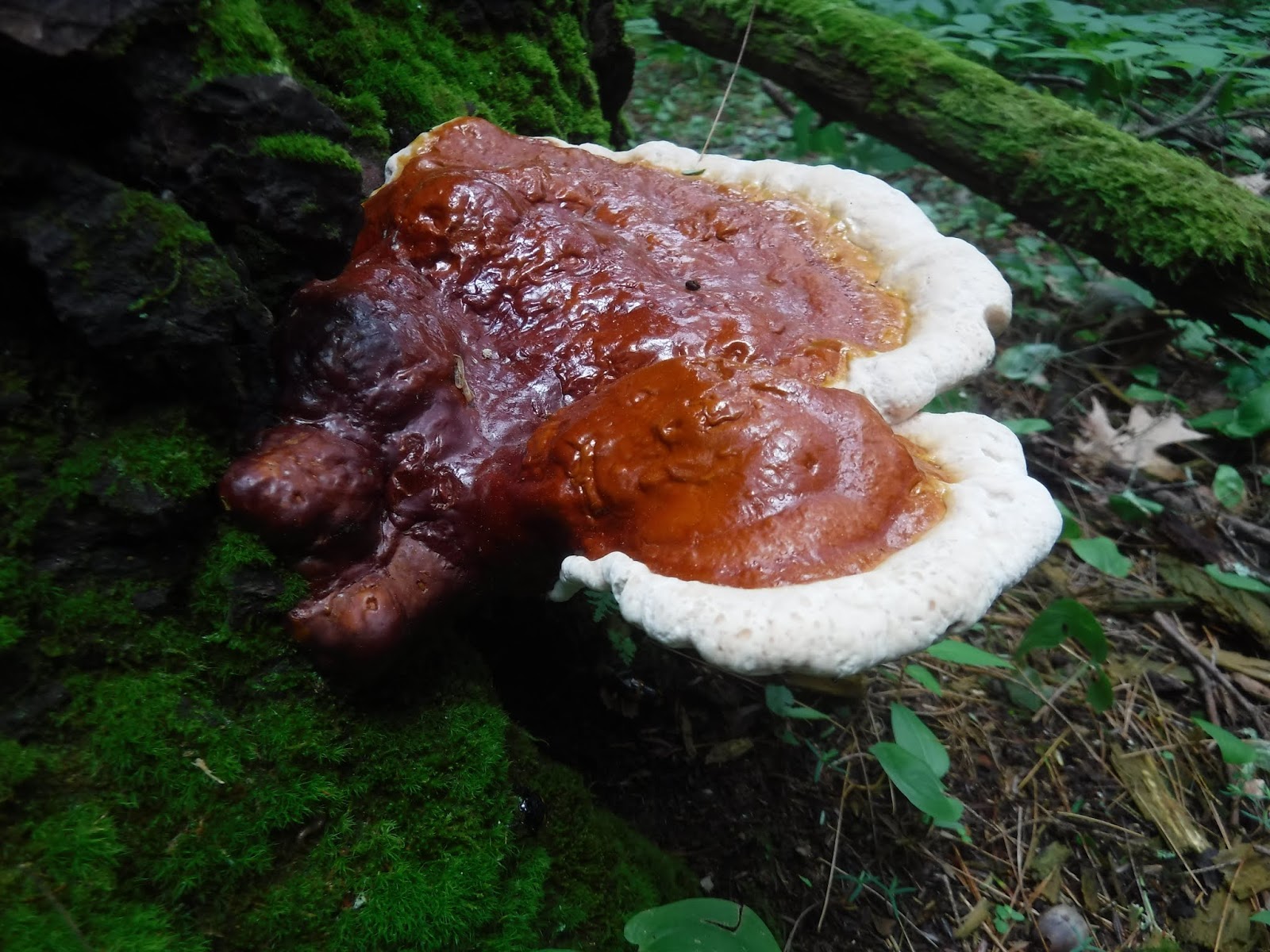
Young reishi (Ganoderma tsugae) growing on an eastern hemlock log
The half-moons of reishi, scientifically called Ganoderma, illuminate our shaded, densely green, forests here in northeastern Pennsylvania. June is this fungi's preferred month for fruiting, bearing mushrooms rich with spores. Reishi has a long history of use and has earned itself such titles as "The Mushroom of Immortality" and "The Great Protector." In this post I'll share with you how to identify and prepare these alluring woodland inhabitants, but first let's talk about this mushroom's multitude of medicinal attributes.

Maturing reishi (Ganoderma tsugae), however still in its growth stage, on eastern hemlock. Notice varnished looking cap, rippled and bumpy near stout stem, these are not uncommon features.
Reishi is primarily considered an immune-modulator. In the herbal world, this means a plant or fungi that works to balance the immune response. If the immune system is under-performing, evidenced by frequent infections, it will strengthen the immune response. However if the immune system is overzealous, illustrated by chronic allergies or autoimmune disorders, reishi will quell overreaction. Although I am sure reishi has an innate intelligence it employs for its own purposes, this modulating action occurs rather scientifically. In the most general terms, our immune system has two modes: clean-up, which uses antibodies to capture and dispose of harmful pathogens, and immune facilitation, which uses antibodies to stimulate histamine and in turn allows for easier transport of white blood cells to an infected site. Reishi encourages clean-up rather than histamine response, activating the immune system to recognize and rid the body of that which doesn't belong.

But reishi works on far more than just the immune system. Reishi contains a wide spectrum of antioxidants (polysaccharides, terpenes, and triterpenes) that nourish and support the body as a whole. In fact, it has been discovered that fifty of these chemicals have not been recognized in other fungi and are unique to reishi. Their effects are anti-inflammatory, hypoglycemic (reduce blood sugar), anti-ulcer, anti-mutagenic, and hypolipidemic (reduce lipids in blood). To top it off, reishi has also been shown to decrease the body's reaction to stress (cortisol production), protect the liver, and assist the body in more efficiently utilizing oxygen, therefore benefitting the heart and lungs. Reishi inhibits viral reproduction. I have used reishi for not only fighting lyme disease but reducing severity of symptoms, in rebounding after surgery and prolonged disease, as a heart tonic, as well as a tonic for general health. Reishi has been used by the Chinese for thousands of years to support both health and mental clarity. Chinese monks even used it in preparation for sitting in meditation for long periods. Today in China, it is used in healing countless maladies, and as a common adjunct to chemotherapy to improve the immune system.
Young reishi growing on eastern hemlock stump
So just how do we find this miraculous reishi in the wild and make a certain identification? Firstly, lets clarify just how dangerous a misidentification of any mushroom can be. Mushrooms are loaded with chemicals of all kinds and many more mushrooms will harm rather than help. Consuming mushrooms from the wild is inherently dangerous, some mishaps may cause irreparable damage to the liver and others are deadly. However, reishi is a good beginning forager's mushroom because there is not all that much with which it could be confused and true look-a-likes are not poisonous.

Reishi grows shelf-like on stumps, fallen logs, or living trees. The two species which we may find in the northeast are Ganoderma tsugae and Ganoderma lucidum. Both can be used interchangeably. Ganoderma tsugae will be found growing on eastern hemlock trees (Tsugae canadensis), whereas Ganoderma lucidum is found on hardwoods. Besides their chosen host, species are indistinguishable.

Plate-like or half-moons of reishi on eastern hemlock - notice the burgundy, yellow, and white coloring
Reishi is a polypore, meaning that the cap's underside bears pores rather than gills. Undersides of reishi mushrooms are white, easily bruising brown, with pores are so tiny that they are nearly imperceptible. With age, undersides brown. The topmost portion of reishi's cap has a varnished appearance. When young, it is burgundy in color, brightening to yellow and finally white at the outermost edge. As reishi matures, yellow and white will darken to burgundy as well. The mature mushroom's general form is stemless and looks like half of a plate protruding from a tree trunk. When very young, some mushrooms may have short stout stems attached to bulbous caps. Reishi is tough and feels more like wood rather than the soft, squishy mushroom we would purchase in a grocery store. For this reason, we would not eat reishi as a food, but it is perfect for using in tea and tincture.

White undersides of reishi, a polypore mushroom, which bears pores rather gills.
As far as look-a-likes, there aren't many. The only mushroom I have encountered in our neck of the woods that even resembles it is Ischnoderma resinosum. It too is a polypore and grows shelf-like on hardwoods and conifers, but it has a velvety cap that is mostly brown in color, gradually bleeding to a muted yellow and finally, white ring. Also, its new growth appears in the fall rather than late spring and early summer. The good news is, if you still make an error, it is edible and safe for consumption.

Harvested reishi, ready to be prepared
Harvest your reishi with a sharp knife, where the cap or stem meet the trunk of the tree - do nut cut into the tree - and carry home to the kitchen. Using a damp cloth, wipe the mushrooms clean of any dirt, bark shavings, or bugs. Then slice thinly, 1/8 to 1/4 inch thick. I put mine in an oven at 150 to 180 degrees and "bake" for roughly two hours, checking and turning them over periodically. Your reishi may take more or less time depending on moisture content. Bear in mind reishi will harden as they cool. You may dry reishi in  a well ventilated room free of humidity as well, by spreading on a screen or hanging slices on strings, but be careful not to let them mold. If you have a dehydrator, even better.
Reishi slices in process of being dehydrated in oven
Once reishi slices are thoroughly dried, crisp and mostly inflexible, they may be stored until needed, remaining potent up to roughly one year. To prepare reishi as tea, simmer slices in hot water, strain and sip. To prepare reishi as a tincture requires an extra step than the typical tincture - a double extraction - so that your medicine contains both reishi's water and alcohol soluble constituents. Infuse slices in alcohol for 4-6 weeks, then strain, be sure to retain mushrooms as well as your alcohol extract. Then simmer mushrooms in water (using 1/2 gal of water to 2 c mushrooms) until water is reduced to roughly 1/3 of alcohol extract. Combine water and alcohol - voila! A reishi mushroom tincture at your ready!

So keep your eyes peeled for this luminous medicinal mushroom, reishi. It's presence is sure to brighten your spirit, and its medicine, your body. You will inherit the strength and resolve to persist through many a season, as does reishi, long after its fresh growth has matured. This find is surely a woodland treasure.


Sunday, May 31, 2020

Enchantment in Delaware State Forest

Amos looking down the trail in Delaware State Forest
Delaware State Forest is an under-appreciated gem. It is comprised of a patchwork of protected lands, encompassing over 83,000 acres in northeast Pennsylvania. A small, but seemingly vast, portion of it has been my stomping grounds providing exploration, inspiration, botanical study and serenity for many years. Just two roads are my only access points by car, neither of which are paved by the time you reach the forest. Mind you, not only are they not paved, but riddled with potholes and ruts. There are few amenities for visitors, but I believe this lack of development has preserved the magic for those of us who enter wilderness for wilderness' sake. When I hike this land, I rarely encounter another person, even during our covid pandemic, and I admit I like it that way. Therefore, although I encourage you to visit this special patch of forest, I will leave it to you to do the homework to learn how to access it by trail. May you have the joy of discovery I have in uncovering its little-visited treasures.

Marsh with beaver dam 
Recently Scott and I explored Yellow Pine Trail, a trail I have tried numerous times to follow to its end, but maintenance is so poor, that much of the trail has overgrown with lowbush blueberry, blackberry brambles and high grasses. However, sunlight streaming through the trees at a sharp bend, beckoned us through woods rife with black birch, witch hazel, and highbush blueberry to see what laid beyond. We soon reached land's end at a marsh. From looking at a map, we decided this was likely Pinchot Brook. The beavers here have flooded the neighboring woods, dramatically widening the creek and making a luxurious home for themselves. An impressive dam retained its waters that reflected the blue sky above. We could see clearly where the materials for construction had been obtained given the gnawed through tree trunks surrounding us.

Evidence of beavers
Grassy hummocks made for good stepping stones and moss-covered fallen logs made homes for northern white violets, while the sucking mud on the shore provided just the right stuff for fuzzy cinnamon fern fiddleheads. Birds flitted to and froe and salamanders glided through shallow water near the shore.

Cinnamon fern fiddlehead
Northern white violet (Viola pallens) 
Inspired by this bushwhack, we decided we'd finally venture beyond another marshy area at the end of Craft Farm Road. We'd walked this gravel and grass forest road many a time before, but always stopped when we reached the crumbling remains of the old Craft Farm and what looked like a pond encircled with white pines. However, the woods whispered to us, err at least me, from the other side. Having spent so much time swamp-walkin' in Florida, I suggested to Scott we just put on our swamp sandals and walk across the thing. But, Scott wisely suggested the mud might be deeper than we think and perhaps we should walk around the edge of it, see if there wasn't an easier place to get across.

Craft Brook
And we sure did! Instead of mucking through mud and algae and swamp water up to our knees, we waded across the slithering Craft Brook, although I did sink in up to my shins when I mistook a hunk of black sodden soil for hard earth. We lunched on the other side beneath a thick leafy canopy on a slab of lichen-blanketed rock and let Amos off the leash when he started protesting.

Amos cooling off in Craft Brook
And with that - lunch was abruptly over. Amos sniffed around the leaf litter for a moment, darting this way and that and then took off like a shot from a cannon headed downstream. We packed up and scurried on after him. Turns out Amos was leading us to the most intriguing aspects of this forgotten place.
Stonewall with passage for creek
While he waded in the creek we enjoyed a stroll across a wide stone wall fashioned with a passage for the creek. Once on the other side, he leapt through the woods like a fox and we tromped over downed trees and beneath the low-hanging boughs of pines, side-stepping many a sun-bathing snake and glimpsing the wildflowers growing along the moist embankment.

Windflower (Anemone quinquefolia)
Meet windflower, one of the very first medicinal plants introduced to me by my mentor, Juliet Blankespoor. It is considered an anxiolytic, nervine, and hypnotic - slightly psychoactive. She promoted its moderate use in trauma, depression, and panic attacks. I have personally never partaken of its medicine, but can remember well sitting in a circle with my peers somewhere deep in the Appalachian mountains admiring its finely cut leaves that have a sort of shimmer and it expansive flower face.

Dwarf ginseng (Panax trifolius)
Here's another beauty - dwarf ginseng - a much smaller version of the wild ginseng that is far more difficult to find in our Pennsylvania woods. Dwarf ginseng, although related, is not considered to have the same medicinal properties as ginseng, which is adaptogenic, but is instead an edible. The tubers may be unearthed and eaten as a trailside nibble.

Amos traverses a downed tree trunk
It took us a solid forty minutes to wrangle that Amos up, who had frolicked his way downstream, back to the trail and all the way to the truck before turning tail and returning to us. So when only Amos and I set out for our most recent excursion, he stayed leashed. Still, together we managed to discover some more beauty unexpected and delve into the mysteries that these woods behold.

Buckhorn Ridge fire tower
Here in Delaware State Forest stands Buckhorn Ridge fire tower, a relic from a bygone era in which men used to staff these towers to keep watch over the forest. Up until fairly recently, one could climb up into the cabin at the top and gaze out over the treetops in all directions. The door in the floor that provided access has now been nailed shut - likely due to vandalism - but that didn't prevent another creature from keeping vigil just below it. Likely this nest of twigs, branches, bark and duff was persistently crafted by a hawk or perhaps even an eagle. Any of my birding people have an idea?

Bird nest just below cabin to fire tower
At the base of this fire tower, upon a mossy bed atop the earth, sprung forth woodland plants. These plants persisted along a long carpet of soft green moss that led from the tower deeper into the woods along the Buckhorn Ridge Trail.

Wild Sarsaparilla (Aralia nudicaulis)
Wild sarsaparilla is a common sight in out northeastern woods, although easily overlooked due to its indistinct divided green leaves. When the plant produces its flowering stalk which arises from its base and also branches three ways terminally, supporting three round umbels of white flowers, it is easier to identify. But it is the root of wild sarsaparilla that is the prize. The root possesses some of the same adaptogenic qualities as ginseng, supporting the body's energy through enhancing the function of the entire glandular system. When unearthed, the root is fragrant and when simmered in hot water for an infusion, delicious. It also provides warmth throughout the body and is useful in combatting chest congestion.
Indian cucumber (Medeola virginiana)
This special plant, Indian cucumber, cannot be found just anywhere, however where you find one, you will often find many. I find it indicative of healthy woods or woods on the rebound, steadily making their way back to balance. Its common name speaks to its tuber which grows laterally under the soil. It is small and slender and white in color and when washed up, makes a for an crisp edible morsel. The flavor is surprisingly close to cucumber but with a touch of heat at finish.

A watery botanical wonderland
Our runway of moss carried us gradually downhill and soon transitioned to rocky trail. At a depression in the forest, we stumbled into the most magical wallow. False hellebore stood tall above the shallow water with roots deep in mud, marsh marigold and ragwort camped on grassy island hummocks, and faces of marsh blue violet poised on long slender stems arose from grass and moss beside fallen logs. Fiddleheads clustered here and there just on the outskirts and sensitive fern, fully unfurled, dappled throughout like footprints through the muck. Amos collapsed belly down in these spring waters, as enchanted as myself.

Marsh marigold (Caltha palustris)
Marsh marigold, a member of the Buttercup family, is indeed edible but not one that I have personally ventured to sample. Reportedly, young leaves and flower buds are edible, after boiled in numerous changes of water to leach toxic glycoside protoanemonin which can cause intoxication and gastric upset. There are other cautionary edibles I do from time to time enjoy, such as common milkweed blossoms and shoots, but this beauty is always one that I've felt more compelled to admire than ingest.
Marsh blue violet (Viola cuculatta)
Any violet in the Appalachians that is blue or white in color, or a combination of, is edible. Leaves are highly mucilaginous as well as astringent - a unique combo - reducing inflammation and irritation throughout the gastro-intestinal tract. Besides all that they are deliciously green in flavor, perfect raw in salads or cooked in any meal. Flowers are edible as well and may be sweet, spicy, or even minty. Use them to enhance any dish with a touch of the wild.

Sensitive fern (Onoclea sensibilis)
A fern guide I regularly reference from 1956 (one of the simple truths of plants - in form they remain the same even over three-quarters of a century) accurately describes sensitive fern's appearance as an "unfernlike fern". Compared to our many lacy- or feather-leaved ferns, it does have a dramatically different appearance. Leaves are short and stout, triangular in shape and backward bending so that they face the sky.

Trail in Delaware State Forest
Making our way down the trail, the forest seemed to spread out all around us. The trail grew increasingly rocky and we moved more slowly watching our steps carefully. Given that the trees had not yet leafed out, we were bathed in sunlight. At our feet, some very special plants made an appearance.
Downy yellow violet (Viola pubescens)
Yellow violets, a sight I always regard as unique as we have so many blue and white violets, but so many fewer species that are yellow. Here we have the downy yellow violet, appropriately scientifically called Viola pubescents. It you look closely you can see its fine hairs adorning leaves and stem. These are not violets that we would eat, but those that offer simply their sunny faces to brighten our path.
Pink lady slipper (Cypripedium acaule)
These broad green leaves with deep parallel veins harken the soon-to-arrive showy pink blossoms of the pink lady slipper. Pink lady slipper is an eye-catching orchid, distinct from all other flowers in our forest. To me, it almost seems out of place in our northeastern woods, perhaps better suited to an alien plant with a kaleidoscope of vibrantly colored vegetation. Sometimes you'll find just one or two of these in a patch, other times you are lucky enough to spot one and then notice them scattered all about your feet.
Moss with rusty-colored reproductive stalks called seta and capsules atop. Inside these capsules are spores that when conditions are dry, will be released to generate more moss 
Slime mold (Hemitrichia) - slime molds were initially included in the Fungi kingdom but are now considered part of the kingdom Protista. The orange cap atop this stalk is a sporangia, containing spores. 
It seemed all around us, new life was awakening, our eyes adjusting to the finer details of the forest the longer we attuned to our surroundings. At another mucky wet area in the forest, dead trees laid across pools of water gathered about the snaking tree roots of yellow birch and provided substrate for mosses now reproducing. Speaking of alien, slime mold probed the gelatinous surface of still water, their orange caps like tentacles reaching upward. In a gnarled tree stump, long decaying, gradually morphing from stump to soil, a community of marsh blue violet flourished.

Decaying stump housing wildflowers
But we could not stay here in Delaware State Forest forever. The light had shifted, it was now late in the afternoon and time to pick up the pace and head for home. So as Amos and I made our way from forest to field, arriving in an old shooting range, the grass about our calves thick with goldenrod shoots and the unfurling leaves of sweet fern, we swiftly made our way to Range Road. Crossing over the gas pipeline, that is an eyesore but at the same time affords views of the trees in flower, I was grateful to have had the time once again in these woods, a place where nature reigns in all her all at once, subtle and magnificent beauty.

Range Road with view of flowering trees bordering pipeline

Saturday, April 25, 2020

Ramps, aka Wild Leeks

Ramps, aka wild leeks (Allium tricoccum)
Down south, we call 'em ramps, up north we call em' wild leeks. Scientifically speaking, they are called Allium tricoccum. Call 'em what you want, there's no denying they are one of the tastiest members of the onion family. However they are also over-harvested. For this reason, I do not often feature them in my writings. So many articles have been written about the infamous ramp, hence their popularity. They top many a foodie's list and speckle the menus of upscale restaurants. But perhaps this is all the more reason to share how we can sustainably harvest them or simply leave them be. Also, we cannot hide our treasured edible and medicinal plants. To learn about our wild plants, especially our human's history of use, is to foster relationship with these plants for years to come. And nurturing our human-plant relationships is more important than ever.

Ramps in a typical mixed hardwood forest, enjoying moist soil and the company of other native woodland plants. Fellow plants are: Virginia waterleaf (Hydrophyllum virginianum), liver leaf (Hepatica), wild ginger (Asarumcanadense), Dutchman's breeches (Dicentra cucullaria), and violets (Viola).
Look for ramps in moist soil in mixed hardwood forests. They particularly enjoy sloping areas alongside lakes, ponds, streams, and rivers. When first leafing out they require a sunny open canopy, but by flowering time need dappled sunlight filtered through leafy treetops. It is unlikely you will find ramps growing in heavily disturbed areas, although I have found them on lightly traveled trails. Look for them amidst our other precious native plants. The photo above highlights a preferred habitat. Notice the Virginia waterleaf, Dutchman's breeches, and wild ginger. They also delight in the company of spring beauty, trout lily, wood nettle, and jewelweed.

Ramps with mottled leaves of trout lily (Erythronium americanum)
Ramps are most easily distinguished by a pair of floppy basal leaves, 1- 2 1/2 inches wide and 6 - 12 inches long. Leaves are parallel veined with a sometimes strong center vein and smooth margins. The petioles (leaf stems) may or may not be reddish.

Ramp leaves, highlighting strong midrib, parallel veins, and smooth margins
Underground ramps bear a slender white bulb a crown of white roots. Think of the white part as a scallion and you'll have the idea. This is the part of the ramp that we do not want to harvest. I'll come back to that in a little bit.
Ramps on washed and ready for use on cutting board
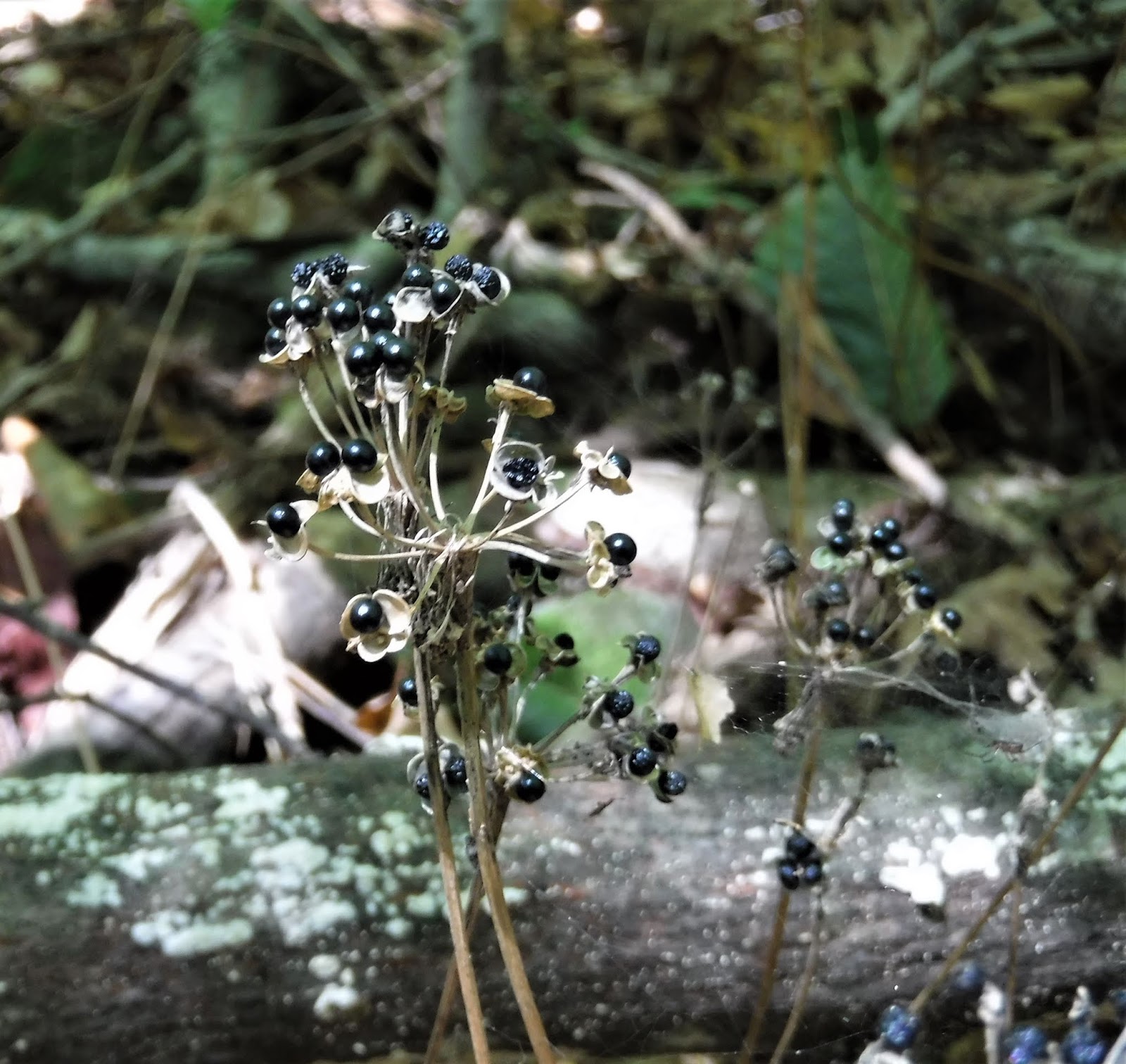
All parts of the ramp will have a garlicy/oniony aroma when crushed or broken. Here in the northeast, ramps will begin to appear in early to mid April and their green leaves will persist until late May. Come June, these leaves will quickly wither away and by July, plants will begin to send up flowering stalks. Each mature plant will bear just one smooth reddish-green stalk with a tight papery sheath terminally. This sheath will unfold its crinkly bracts revealing an umbel of small white to cream-colored flowers, each with 6 petal-like parts. Finally, in late summer, flowers give way to round shiny seeds that resemble tiny black pearls.

Ramps in seed stage
Ramps are in danger because we humans are overzealous when it comes to this wild edible. Folks will pay big money for ramps at farmer's markets and chefs are always eager to craft the next creative dish. However, we should only be wild harvesting ramps for our own use - that means yourself and your family. Secondly, we should only harvest ramps from those places that are abundant in ramps and from where others are not harvesting as well. Find your ramp spot and keep it secret! 

So just how do we sustainably harvest our moderate amount of ramps for personal use?
Ramps take seven years to reach reproductive maturity and are more likely to reproduce by bulbs than by seeds. Therefore it is imperative that we leave a portion of the bulb in place when we dig for ramps. Use a digging knife to dig the soil around a ramp, exposing its bulb, then be certain to cut well above the rounded bulb, leaving the bulb and roots in place in the earth. Distinguish ramps by their seed stalks and you can harvest the bulbs late in the season after the plant has dropped its seeds. That is, if you must dig for bulbs at all. The leaves are equally flavorful and may be sliced just above the soil. Take just one from each plant and you are doubly likely to ensure a plants survival.

Ramps with peppers and onions to be sautéed 
So, now what do we do with these ramps once we have carefully procured them? They are incredibly versatile and accent most any savory dish with a unique garlicy flavor and aroma. I leave leaves whole or dice and use in veggie sautes, scramble with eggs, use as a pizza topping, and simmer in soups. Don't use them in combination with too many other stronger tasting veggies or they may get lost in the mix. Use them in a recipe where they can shine. Recently I sautéed ramps with mushrooms and baked them in a quiche, topped with purple dead nettle flowers.

Quiche with ramps, mushrooms, and purple dead nettle flowers (Lamium purpureum)
Ramps also make an vibrantly green, tastebud-tingling pesto. And this pesto requires no garlic! Coarsely chop ramps leaves, then combine in a food processor with olive oil.

Ramps coarsely chopped
Add grated parmesan and/or nuts if you like, then puree until mixture is creamy. I am not big on exact measurements. But I suggest going light on the olive oil to start and gradually adding until you reach your desired consistency. Brighten and preserve your pesto with a squeeze of lemon and put on the finishing touches with a bit of salt.

Ramp pesto
Just a dab will do of this pesto. Blend a half teaspoon with a cup of ricotta cheese to top pasta or pizza. Smear sparingly on crusty bread or cheese sandwiches. Since just a little goes a long way, freeze the remainder of your pesto in small containers until needed. 

A couple more important notes on ramps.

Firstly, be careful not to confuse ramps with Lily of the Valley or False Hellebore. Both of these plants are toxic and when first sprouting, they strongly resemble the leaves of ramps. False hellebore, in particular, will often share the same habitat with ramps as well. Get to know these plants before harvesting ramps. Here are a couple of helpful links.

Lily of the valley - https://pfaf.org/user/plant.aspx?latinname=Convallaria+majalis
False hellebore - https://pfaf.org/User/Plant.aspx?LatinName=Veratrum+viride

Lastly and not least importantly, there are many other, less threatened plants we can harvest that have a garlicy/oniony flavor. My very favorite is garlic mustard, a non-native invasive that we would be doing good to eat. Check out my blog post about how to identify garlic mustard and puree into a pesto here:  https://thebotanicalhiker.blogspot.com/2015/04/presto-garlic-mustard-pesto.html Wild onions or onion grass is yet another. You'll be able to locate this one when mowing your lawn. Smell onion? It's right beneath your feet and looks just like grass but with hollow leaf blades and an oniony smell.

Ramps are delicious but precious native inhabitants of our remaining wild places. Please consider and handle them with reverence.

Wednesday, April 15, 2020

Southeast Journey - Connection amidst Covid

Wise Man, Joan Jarvis, Bot, and Amos (I'm pretty sure Amos is hoping Joan's got some more sour cream for him)
From Withlacoohee State Forest, we continued our journey south to reconnect with a very special trail angel, Joan Jarvis of Oveido, Florida. Joan was a life saver, or shall I say a thru-hike savior, last year when we were on the trail. She assisted us in so many ways. She helped Scott get to an outfitter for a much needed pair of shoes, kept us dry during a very cold all-day rain, and made sure we were well-fueled with many a home-cooked meal. But, it was her company that kept us full in spirit. She is a long-time supporter of the Florida Trail and its hikers in so many ways. On this visit, Joan graciously allowed us to park in her driveway for two nights and we rejoiced in her company and good cooking once again. Amos got his first taste of chicken, sour cream and bacon bits and may never be the same. He deemed her his travel trailer angel! While with Joan we also had the immense pleasure of spending the afternoon with Sandra Friend and John Keatley. Sandra and John have authored countless books about hiking in Florida as well as the comprehensive website FloridaHikes.com. They have supported hikers through their research and commitment for many years. Their book, A Guide to the Florida Trail, proved invaluable during our 2019 thru-hike.

Prairie along the Florida Trail
Sandra suggested we gather at Joan's rather than a restaurant to "socially distance." We first thought Sandra was simply in  need of some quiet time and as fellow hikers, we get it. This was the first we'd heard this term "social-distancing." But she soon clarified for us that these recommendations were coming from the CDC. Sandra, John and Joan, caught us up with the pandemic unfolding in the rest of the civilized world. The local news then declared that Seminole County, which was where we were, had it's first covid case. Next, we received a text from home that our county in PA had four cases. Covid was getting real. I realize covid had been very real overseas for some time, but it was the first that we actually grasped the reality of its being on our very soil. From here on out, our Southeast Journey would begin to quickly change form. We decided we'd retreat to one of the most empty places we knew - the Florida prairielands.

Wise Man, Peacock, and Bot
We bid our friends adieu and later in the day we found ourselves on desolate roads in Desert Ranch. These roads are home to the Florida Trail for roughly thirty long miles. The walk is mind-numbing with nothing but farm-fields and powerlines as far as the eye can see. We thankfully had the help of trail angel, Trucker Bob for part of this section. It would have been hard-goin' without him! When all of a sudden we spotted a figure in the distance. As we grew closer we could see he wore a backpack and carried hiking sticks. A thru-hiker! We were delighted to pull over and say hi. One of our big movitators for returning to Florida this year had been to provide trail magic to this year's hikers, however since we'd gotten such a late start, the typical hiker season was nearly over. We hadn't expected to find one this far south. Meet Peacock, who was out for his first long hike. Being a Florida native, the high temps he'd be walking into as spring progressed didn't scare him. He happily received a cold beer from our trailer fridge and we passed along some of Joan's homemade fudge - both were gone in a gulp! More evidence of how trails build connections not only between places, but people.

Scott and Amos walking beneath Spanish moss on Hickory Hammock Trail
We found ourselves a campsite at Hickory Hammock Equestrian Campground, free of charge, through the South Florida Water Management District (SFWMD). The SFWMD generously allows folks to camp without cost on its lands. Sites must be reserved through their website, which can be a little tricky to navigate, but its well worth it, as sites are often remote, not overcrowded, and in beautiful locations. We parked beneath the limbs of a live oak that provided much needed shade in temps that were continuing to rise as our trip carried on, and enjoyed a peaceful night. The next day we took a hike on the Hickory Hammock Trail which runs 11 miles, paralleling the Florida Trail, and passed directly through our campground. We walked sandy sund-drenched paths through saw palmettos, bowed beneath live oaks draped in Spanish moss, and rejoiced in the company of palms. And the array of plants we spied within even our first steps were astounding.

Netted paw-paw (Asimina reticulata)
In my time in Florida I have spotted far more paw-paws than I ever have in the Appalachian mountains. However, here in Florida, those I have seen are of the smaller variety. The woody-stemmed netted paw-paw, scientifically named Asimina reticulata, grows no more than roughly four feet tall, but is related to the full-sized tree Asimina trilobal, that which many of us think of when we think of paw-paws. However Florida's smaller species, such as this one, also provide edible fruits. The flesh is reportedly fruity tasting and loaded with protein. However be cautious in consuming them as some people can have allergic reactions. The seeds and skin should not be eaten under any circumstances. I have yet to try one of these native fruits. Have any readers tried a smaller species paw-paw?

Cardinal airplant (Tillandsia fasciculata)
Cardinal airplant (Tillandsia fasciculata) is a state-listed endangered plant. Airplants enjoy the forest canopy, taking up residence on tree branches. We found a couple of these plants upon the ground, still attached to a fallen limb. The leaves of the cardinal airplant are long and sharp-pointed creating a gray-green rosette. However, its purple flower and pollen-coated stamens were most eye-catching. Due to an introduced Mexican weevil which bores into airplants, the cardinal airplant is presently endangered.

Rabbit tobacco (Pterocaulon pyncostachyum)
Here's a plant with a fun name - rabbit tobacco - a fitting one to discuss in our Easter season. However, what it's got do with rabbits, I don't know, perhaps it is rabbit height. Native Americans would smoke the leaves as a tobacco substitute, hence the tobacco reference. Another common name is blackroot, for the reason that the roots produce a poisonous black sap. It's an altogether strange looking plant that to me resembles a fat purple-tipped pipe cleaner.

Campsite marker on Hickory Hammock Trail
Although not part of the Florida Trail thru-trail, Hickory Hammock Trail is still considered part of the Florida Trail and is complete with a backpacker's campsite, which we hiked to, making for four miles round-trip. We kept Amos well-paced on this day and were certain to carry not just a liter of water but a gallon for our boy. We've been learning that hiking with a dog is oh so different from hiking without one - it's paced us as well. We're sauntering as John Muir would have liked. All the more time to notice the plants! And critters like this...anyone know what we have here?

Frog on palm frond - anyone know this guy's name?

Oh and climb trees...

Hanging out in a live oak - trickier to climb than they look!
We spent the next two nights at Starvation Slough campsite, another SFWMD site, and we had the place completely to ourselves. It was dreamy. Even if Amos periodically awoke to a wild hog passing through, which he scared off with some tremendous growling we'd never before heard from him. While at Starvation Slough we took an eight mile hike out-and-back to Starvation Slough North campsite along the Florida Trail. This was one of the first portions of the Florida Trail we ever hiked and has remained one of our favorites. It leads you through fields filled with primrose willow shrubs and past a deep pond, surely home to alligators. Here we spied some plants we've seen time and time again in this very spot.

Maryland meadowbeauty (Rhexia mariana)
Maryland meadowbeauty is a beauty indeed with conspicuous stamens and pale pink petals. This is a flower I also regularly enjoyed finding on the Mountains to Sea Trail, although deciphering between species can sometimes be tricky.            


Orange milkwort (Polygala lutea)
This flower is a common sight in the prairielands. Orange milkwort or Polygala lutea, is also called candyweed because some species' roots smell of licorice, such as Polygala nana. I have pulled up Polygala lutea in the past and was certain that I smelled licorice, however I now cannot find evidence to support my memory. I'll have to try another when we return. Nonetheless, this licorice smell leads me to wonder if these species contain methyl-salicylic acid, a known pain reliever and anti-inflammatory. Locals simply call it "swamp Cheetos" because perhaps being low-to-the-ground as it is, it looks just like that - like some poor hiker dropped a cheese puff in the grass.

Live oaks along Florida Trail between Starvation Slough and Starvation Slough North campsite
After the pond, the trail carries you beneath canopies of live oak, branches intertwining overhead and adorned in wild pine air plants and Spanish moss. The sound of the breeze through the large fronds of  squat cabbage palms was dreamy. We encountered wild oranges that we now knew better than to try and eat - these were very bitter last we tried them - but the smell of their blossoms still lingered. Intoxicating. It was hot but the forest canopy made for dappled sunshine and we were all grateful for the shade. Amos clearly was adapting to the Florida temps as he completed this hike without a hitch, however he sure was ready for a dunk in Starvation Slough when we again neared camp. Worry not, we did inspect it for gators first!

Amos cooling off in the muddy waters of Starvation Slough
Although isolated in the prairie, we were not without cell service, and the texts from home kept coming. We talked to our friends back in Asheville one evening and they were in full on social distancing mode, which is not easy in the shared homes in which many of them live. Although we were basking in the Florida sun without a care 'cept for the gators and hogs, these texts and phonecalls were foreboding. We questioned if we should head south to see Scott's mom in Sarasota as planned. She assured us we should come nonetheless and so we braced ourselves for the big city, packed on camp and hit the road.

Spider web - these net-like webs ornamented the palmetto fronds, glistening in the morning dew in Apalachicola National Forest
We visited Mom and felt safe and secure in her condo, we dined in by choice, and enjoyed homecooked meals yet again. Amos spent the day at his first dog-sitters - Auntie Kara's Canine Camp - and rocked it. Look her up! She was amazing, so patient with the worrisome parents and so caring with Amos. Of the six dogs he shared the camp with, he chose to make best buds with her nine-year 8-pound chihuahua, Fenway. While visiting, we had do a shop as did she and so we ventured out to several grocery stores in the area. In the midst of our errand running, we got word from back home that all but essential businesses were now closed and restaurants were on take-out only. My mom phoned and reported that she would be catching the first flight back to PA from Illinois where she'd been visiting her 99-year old father due to her later flight now being canceled. For the first time, seeing empty shelves in the supermarket and the fervor with which people shopped, put the fear in us. Covid was now undeniably real. As much as we would have loved to stay and visit with Mama Weis longer, we no longer felt safe in this metropolitan area, rather like bugs caught in a spider's sticky web, in immanent danger. Vulnerable. We spent the night in the parking lot at Big Slough Preserve, 40 minutes east of the city. It was illegal to camp here overnight but we were unable to find a single campground with any vacancy and hotels that took pets were over three hundred dollars a pop. We got through the night without a hitch, were greeted by an equestrian rider in the morning and promptly headed back north for the panhandle. The wilds of Apalachicola National Forest never seemed so safe!

Lady lupine (Lupinus villosus) - clumps of these colorful lupines dotted the sandy soil near our campsites in Apalachicola National Forest
We retreated to known places - first the Jewel trailhead for two nights - the same place where we'd met up with Flat Top and Steps and then back to the dry swamp in the shelter of pond cypress trees. Within just a couple of days, campgrounds had closed in both state and national forests and we felt less inclined to cruise around burning gas, looking for novel places to camp. We were doing our best to hunker down. One day we took a hike, heading south, on the Florida Trail from the Jewel trailhead towards Porter Lake. The trail was blissful and in much better repair than what we had remembered from the year before due to hurricane damage. We hiked amidst long leaf pines and saw palmettos, letting their roots and boughs take our worries, while marveling at the wildflowers that seemed to not have a care in the world.

Sweet pinxter azalea (Rhododendron canescens)
Sweet pinxter, a native azalea in full bloom, speckled the green understory. It seemed spring had truly sprung. Nature would continue its cycles even if life as we knew it was coming to a grinding halt.

Bearded grass-pink (Calopogon barbatus) - the "beard" is the yellow tuft at tip flower and pollinia is at tip of curved reproductive column below
Bearded grass-pink, an eye-catching orchid, illuminated the grasses here and there. It's scientific name Calopogon means "beautiful beard" and that it had. I couldn't help but notice what looked like a tiny drop of dew on a curved petal. Further research has told me that this "curved" petal is actually a reproductive column that contains pollinia (mass of pollen grains). Pollinators, such as bees, mistake its yellow "beard" for stamens. When then dive in, the weight of the bee forces the upper lip to bend downward, unknowingly dunking the belly of the bee into the pollinia. These flowers are pretty clever.
Dwarf sundew (Drosera brevifolia)
Here's another wildly unique plant, dwarf sundew, scientifically called Drosera brevifolia. It may look sweet and mild-tempered, but if you're an insect...watch out! Sundews are carnivorous. At the base of the plant is a small rosette of scarlet leaves. Each of these leaves possesses stalked sticky mucilaginous glands - these can easily be seen with the naked eye - which trap insects. This mucilaginous secretion is also rich in enzymes which then works to digest the insect and provide nutrients to the plant. Look for sundews in damp sandy soil.

Scott and Amos on Florida Trail between Jewel trailhead and Porter Lake
However, upon returning to camp after our hike we were met with a horrific site. We were covered in ticks, from full-bodied to so tiny they were nearly translucent. We picked them off ourselves as best we could and then got to work on Amos. This poor guy had them in his crotch, behind his ears, and even in between his toes in the pads of his feet. Being from the northeast, we're used to ticks, but this was like nothing we'd ever seen. When we hiked the Florida Trail last year, we had no more than a few ticks on us the entire hike. We hadn't even been worried about them this time around. Apparently a week of higher temperatures makes all the difference. Terror overwhelmed us at the thought of getting sick and not knowing if we had covid or lyme. I've had lyme. It's not pretty. And these ticks, with a conspicuous white dot on their backs -lone start ticks - were not like those we have back home. A little google work some days later put us a ease, when we read that, according to the CDC lone stars do not carry lyme. In fact, they carry a bacteria that can allegedly counteract lyme, although I think this statement must be oversimplified. There bacteria can cause various other problems, like a red meat allergy, but given the fact neither of us has even red meat in over twenty years, that wasn't a worry. Still, we couldn't bear the thought of another tick infestation for poor Amos or us. So our next hike took us back to Saint Marks NWR where we hoped the ticks were lesser.

A crane amidst palms in Saint Marks National Wildlife National Wildlife Refuge on primitive trails
We began at the parking area for primitive trails not far from the park entrance. Here we hiked a roughly six mile loop (following trails 105A-114-127-106) that was stunningly beautiful, even if a little frightening for we were flanked on both sides by canals nearly level with the trail. We kept Amos close and never did have to wrestle alligators however we startled flocks of strange birds and spied a cottonmouth making his way through the dark waters beside us. The flowers of every color guided us, giving us safe passage. Ticks were nowhere to be seen.

Southeastern sneezeweed (Helenium pinnatifidium)
Southeastern sneezeweed stood tall and shook in the light breeze. Reportedly Native Americans would dry and powder sneezeweed to use as snuff. Sneezeweed could be confused with tickseed, however they have wider "button" or circular arrangements of disk flowers at their centers.

Swamp leather-flower, aka fairy hat (Clematis crispa)
Swamp leather-flower hung humbly amidst the low walls of green vegetation to either side of the trail. This would be an easy one to pass by as they dangle inconspicuously from twining vines. Another darling name for these flowers is fairy hats, which should you stumble across one, you'll see why. Cup-shaped, they bow their plant faces towards the earth, curling only their petals upward like the brim of a hat.

Following Florida Trail along Sopchoppy River bluffs - notice the knobby knees of cypress knees and exposed roots
The last hike we would take in the Florida wilds would be on the bluffs of the Sopchoppy River. We hoped that here too we could find a less tick ambushed trail. We parked at Oak Park trailhead and walked to Monkey Creek. Old man's beard (Usnea), a highly medicinal lichen, hung in clumps from tree limbs, knobby cypress knees protruded from the Sopchoppy's black waters, and we startled a fox that went leaping through saw palmetto. We hadn't planned on this being our last hike, but when we returned to the parking lot, roughly 3.5 miles later, we and Amos were again littered with ticks. That evening, while camped in the same parking area, we decided the high temps, ticks, and fear of covid was enough. Also we hadn't had a shower since Sarasota and there was no hope for another with campgrounds closed. Wet wipes only go so far. It was time to say goodbye to Florida until next year and head towards home. 

Sunbathing outside the trailer, see Amos in his background, at Starvation Slough campsite
But we were reluctant to let go of the adventure. We decided we'd head north by way of Mississippi. I had never been and there were national forests there where we could boondock. Also, temps looked lower, so perhaps ticks would be lesser. Covid cases were still few and the weather looked good. We drove nearly seven hours and landed in Bienville National Forest at nightfall only to find a locked campground and a sign that read: Closed due to Coronavirus. It was like something from a bad horror movie. We tried in vain to find a roadside pull-off, but the forest was flooded. Narrowly we managed to turn round after venturing down a bumpy sand road and parked just in front of the campground. That night, a train barreled by every few hours, blaring its horn, less than a quarter mile away, its lights shining through the trees into our camper. In the morning we explored the Shockaloe Equestrian Campground, also home to a 22-mile trail. It looked lovely. The smell of sweet wisteria flowers filled the air. It was all so bittersweet. Then we took a look at the weather forecast. Tornadoes, heavy rain and hail were predicted from here to central Tennessee. That was it. It was time to get home.
Amos at ease in his very tiny home on wheels
We drove ten hours - the furthest we'd traveled with the travel trailer in one day - making it near delirium, just north of Knoxville, Tennessee, and more importantly just north of the storms. A Bass Pro Shop seemed a fine place to call it a night. The parking lot abutted forest and we shared it with only a lone Mack truck. Amos was remarkably better, even in this paved paradise, and we remarked on how far he had come. We'd gotten into this peaceful routine of arriving at camp every night, and while we popped up the trailer, cleaned up and got dinner cooking, he'd dig himself a shallow hole in the dirt and lay down to nap until sundown. Even then, we'd often have to pull him inside, where he'd chew on a bone for a bit and sack out for the night. In the morning, he stirred when we did and would bound to the truck with excitement as we folded down the trailer. This from the dog who on the first night of our adventure, whined and fussed for three hours straight. This from the dog who, back home, would quiver to even drive through a tiny town. This from a dog who would pee on the floor in fear when entering a new space. He brought such joy to our days from car rides to hikes and we brought to him security and love and in the process, he'd become brave.

The next day was the same, a ten hour drive, this time with flashing alerts all along the highways that blinked, "Practice Social Distancing" and "Shelter in Place." My parents back in PA called us to tell us how very relieved they were that we were returning. We were too. It would not have been responsible for us  to continue our journey, nor was it safe with the need to use public facilities and fill up on gas on the regular. We also knew to fall ill in the wilds of a national forest would be a dire situation for not only us, but undue stress placed upon a small neighboring trail town. But, still we wondered if we were really any safer to be driving closer to the epicenter. Milford, PA is after all, just 90 minutes from New York City. But alas, we'd be home, which felt like a pretty safe place. On the way, we washed our hands after every gas stop and made a point to pull off and pee in the woods rather than use a restroom. We were eager to be off the road. We made it as far as another Bass Pro Shop outside Harrisburg, PA and slept with one eye open, near a busy intersection threaded with periodic disconcerting passerby. In the morning we awoke to pounding on the door from mall security. He stated firmly, "You can't stay here." We assured him he would be on our way asap and in a less gruff town, replied, "Stay healthy." By noon that day, driving through light snow into our flat-topped Pocono Mountains, we arrived safe and sound. Amos ran circles on the lawn.

Hickory Hammock Trail 
We are grateful to have had the time that we did down south. Every single day of our roughly five-week venture was a gift. We are thankful to be healthy and to have all that we need. We are blessed to be in the company of family. Our journey was graced with friendship, tremendous beauty, wonder, and of course so many a unique flower. There are still so many places we wish to revisit in Florida and still so many places we wish to explore for the first time. To this we have to look forward. Thank you to all who made our experience truly a journey of the heart and soul. We'll be thinking of you and those towering cypress until we meet again...
  
Scott amidst the pond cypress trees in dry swamp, Apalachicola National Forest