Friday, September 9, 2011

King's Canyon and Yosemite, California

Driving into California on "the Loneliest Road in the US", we rolled along atop a continuously unfurling carpet of purple-gray sagebrush and happy-yellow rubber rabbit bush, bordered on either side by tall red-barked dark-green needled Jeffrey Pines, gazing at the the white-rocked Sierra Nevadas on the horizon. I felt as if my heart my leap out of my chest. I tried to snap pics from the car and was elated when my father announced he needed a pit stop on the side of the road, allowing me to wander a ways up and down the road in pure awe.

It smells different here. Evergreens and Cedar mingled with dry dusty air. Did I say dry? Clothes dry in seconds, nose bleeds happen at random, and skin about my ankles resembles chalk.

I believe my heart actually did leap from my chest and landed with a splash! at the sight of Mono Lake. This is a crystal clear blue glacier lake, featured in many of John Muir's writings on California. This time I insisted we pull the car over and I ran as close up to it as I possibly could, opening my arms and lungs in an attempt to draw just a bit of it moisture in.

However, upon entering the "village" of Mono Lake just outside Yosemite...my ethereal California experience abruptly disinegrated. My father and I found ourselves at a bustling gas station complete with over-priced gift shop with Muir's name and photo stamped upon every magnet / t-shirt / keychain possible, espresso bar, cocktail bar, sandwich shop, a live band blaring away outside, and not to mention, charging $4.50/gallon. However, this was only a taste of the "Yosemite Experience" , for my father and I had rather naively followed his vehicle's GPS unit into Yosemite National Park simply to get to King's Canyon National Park just south of here. Let me just say, do not attempt Tioga Pass (the main road-windy and mountainous) at 8pm at night after 10hrs of driving on Labor Day weekend.

I'll return to Yosemite in just a bit.

So we eventually find our way to King's Canyon - after an overnight at a Fresno Motel - and thanks to an amazingly helpful and kind ranger named Mary--thank you, Mary!!--found a lovely campsite just outside the park in Sequoia National Forest completely to ourselves, without any of the hub-bub of a busy campground. We camped beneath towering Sugar Pines and beside Sequoia stumps the size of cars.


Here we hiked in the evening to the Boole tree- this tree measures 113 in circumference- and bestows a strong presence to the woods surrounding and supporting it. We had to revisit it the next morning for the simple fact that it was too much tree to take in in just one sitting.


While in the park we also hiked through an extensive Sequoia Grove. We had marveled at several large trees on display the day before upon entering the park, however to walk amidst them in a forest is a whole different experience. These trees are so big it would take 20 people with arms outstretched to surround one's trunk and they stand stories tall- some 250ft tall.  They are estimated to be 2000-3000 years old with dead trees standing and lying about for easily 1000 years longer since the wood is not subject to fungus and therefore not quickly decomposed.


So after our splendid stay in King's Canyon, we headed back to Yosemite.

We re-entered in the region of the park known as Wawona, passing the Yosemite Lodge (rates start at $385), numerous markets, and a golf course. Overwhelmed, we sought the help of a ranger at the visitor center.  This man was quite friendly and informative, but I can't say after a run-down of  "Well you could camp in the park, but considering this weekend we're filled to capacity approaching our mark of 5million visitors, it might be difficult to find an unreserved spot..sure you can camp in the backcountry but you have to get a permit first and we'll have to figure out what trails still have permits available...oh and you'll have to rent one of these 3lb bear canisters for your food...oh, the half dome, sure you can do that, but you'll have to call ahead to reserve one of the 400 permits we dole out daily to climb it...and a fire, well here, just fill out this permit...and you can pick up this trail here on the other side of the park only about two hours away...and this other trail over here about another hour away...and then make your way over here where you can hop on a shuttle bus with 100 other visitors...and don't forget to check out the watercolor classes happening over at the studio...and these should help you some," quickly piling up a stack of Yosemite maps, trail brochures, and activity pamphlets on the counter before us, made us feel any less overwhelmed.

We spent the evening sorting and planning and over the course of the next three days, miraculously, found the nature of Yosemite, experiencing just a taste, a tiny morsel, of the beauty and wilderness that Muir experienced in his explorations of and communion with this area over 125 years ago.

Camping in the National Forest just outside the park, we hiked to the Chilnuala Falls in Wawona the first day, climbing 2400ft up over 4.5miles, through a forest of Oak, Jeffrey Pine, Cedar, and Manzanita, and over granite slabs of rock. The sun was hot, but the breeze was cool, and the views were phenomenal.

The second day we moved into the Yosemite Valley, hiking to Taft Peak and Sentinel Dome. Sentinel Dome providing sweeping views of the mountain-tops and valleys in every direction. Here I laid eyes upon other Muir admirations such as Cathedral Peaks, El Capitan, Mt. Ritter, and Yosemite Falls. I also enjoyed a wonderful wildflower walk with a ranger name Phaedra at Bridalveil Falls Campground, finally learning the names and some uses for these west coast plant beauties


I promise plant pics and info as soon as I get more wifi and time to sort through them all!!

On our last day we explored the Pacific Crest Trail and Tuolumne Meadows. Here my father and I climbed to an unmarked granite dome, claiming it our own with the name "Let's GO!" Dome, jogging across it flat-top surface, and gazing down to the meadow and across the nearby domes around us. I envisioned simply running and jumping from one granite dome to the next. I finished off the hike with a celebratory dip in the icy cold falls of the Tuolumne River below that followed us along the trail.


After a winding drive through the mountains of northern California, we are today leaving the town of Eureka and heading onto our final exploration before heading back to PA, Redwood National Forest. The Sequioas are large around, but these are towering tall. We should also get a taste of the coast and some protected prairie land.

Oh...and we did pass through the infamous Humboldt County, where I ran  into this big fella...Bigfoot!!

Thursday, September 1, 2011

Canyonlands, Utah

Oh my...holy...freakin'...beautiful...red sandstone mesas, buttes, and canyons!  Utah has proven to be far more breath-taking than I ever could have imagined. I knew this state was known for its alien-like sandstone formations and deep canyons, but never would I have expected the stratified rock of every earthly color possible.


My father and I visited Canyonlands National Park and though we'd only planned on one day here, spent three days instead. We hiked many short trails the first few days, seeing the ancient granaries still in pristine condition from the native peoples- we happened to be here in the midst of a soaking rainstorm and we literally had to cling to the side of the slickrock butte while scaling down its smooth side, as well as wide overlooks of the canyons and surrounding White Rim below- this is formed by salt deposits. However, the trail that took the cake was the Murphy Loop Trail. Here we descended 1400ft into the canyon, reaching its very bottom, walking a wash. The steps were steep and guided us in short switchbacks up and down the canyon's side and the wide open sky baked us in the hot desert sun. It was like being inside a giant blue sky, red sandstone oven, and it was beautiful.


We also took a dusk-time visit to Horseshoe Canyon, 30m down a dirt road into the middle of nowhere, driving by nothing but mesa, sagebrush and cactus, and having to stop for the periodic cow or horse crossing- these guys were completely free-roaming, not a ranch in sight for miles. Here we camped the night in the parking lot and descended into the canyon the next morning to see the petroglyphs left by ancient peoples believed to have lived in 1000 - 2000BC.


The soil here is crushed red sandstone, some of it bleached white by sun and time, however it supports a hardy collection of desert-loving plants, such as Prickly Pear clustered together in tight communities, various fragrant Artemisia (Sage), cottony members of the Goosefoot family, Juniper trees, and Pinyon Pine.


Cottony Goosefoot


Prickly Pear


Juniper
 Unfortunately I will have to keep this post short, as we are quickly continuing on our way. We spent the night here in Ely, Nevada, at the Historic Nevada Hotel and Casino. The hotel was lovely, full of old trinkets and antique furniture, however the downstairs and outside of the building was a circus of flashing lights, dings, and whistles- though we did enjoy complimentary margaritas here! We are now going to drive the "loneliest road in the US" through Nevada and into California where we'll explore King's Canyon and hug the giant Sequioas.

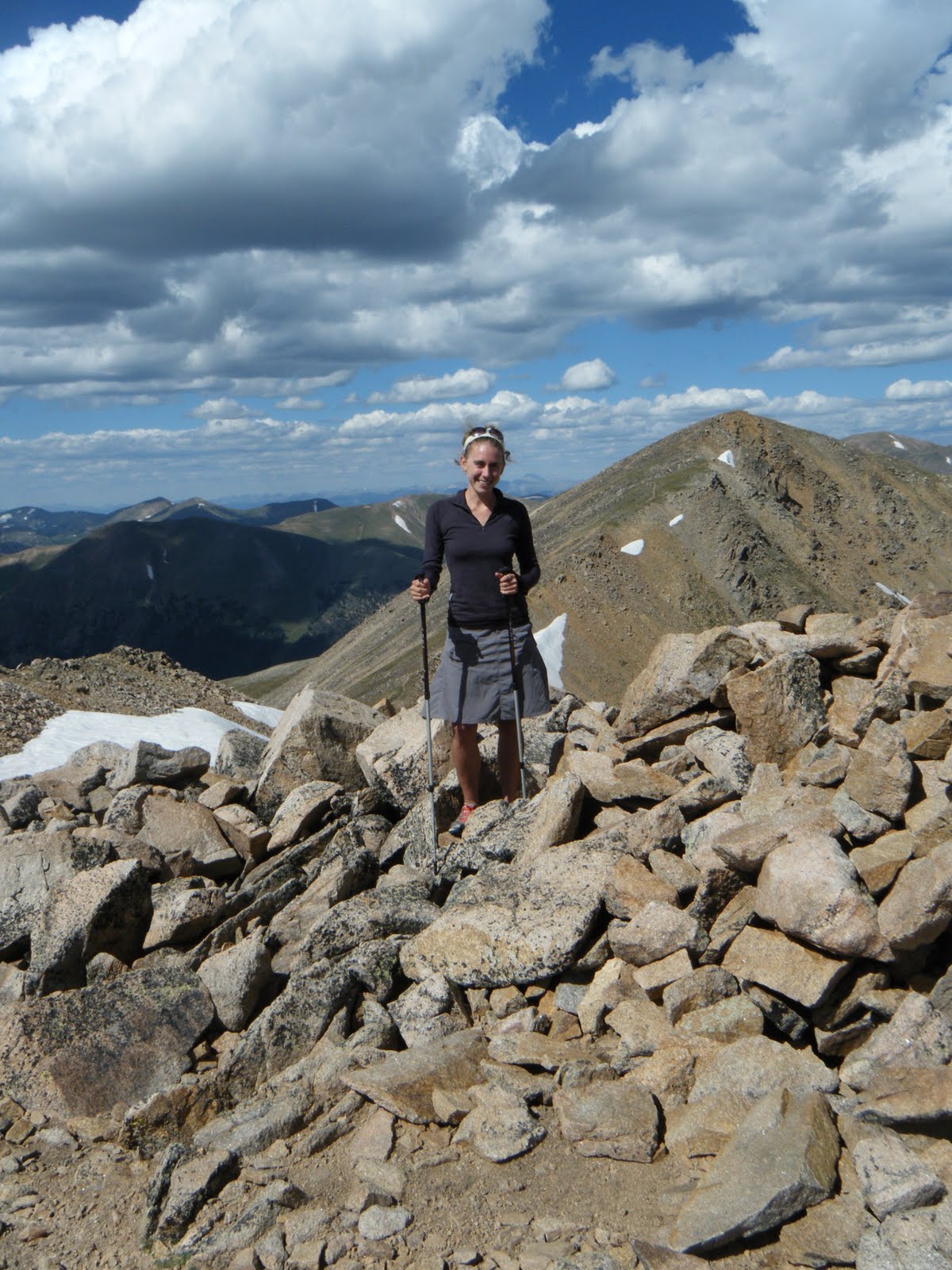
Oh...and one more thing...I just must brag about summitting my very first 14,000ft mountain, while in Colorado, Mt.Gray, which my father and I named Mt.Francis in honor of a sweet elderly kitty that passed at home while we've been away.

Friday, August 26, 2011

Victory on Mount Victoria and Adieu to Colorado

Okay...so my father and I have come to learn something here in Colorado...when the prospective trail is described as "Moderately Difficult", it really truly means that there is a significant level of difficulty. When the trail is listed as "Strenuous" it will indeed be strenuous, and when the trail is described as "Easy"...well we haven't encountered any of these easy trails yet.


However, even with this lesson, we began to wonder who had come up with the description of "Moderately Difficult" for the trail to Mount Royal as we hoofed it up a steep avalanche path and slid one step back for each step up over scree (loose rock) and sandy dirt, and as the trail continued up, up, up, for what surely seemed more than 1 mile. But up we went, in awe of the surrounding Lodgepole Pine and Engleman Spruce and the views of Frisco below, and the challenge of the trek.


Almost to the top we ran into a couple coming down. We got to chit chatting as they, too, stumbled and slid over the loose rock. I mentioned the enormity of Mount Royal, upon which the woman responded with a smile, "Oh you passed Mount Royal a looooong time ago!"

Huh?

Turns out there was a sharp righthand turn we missed about a mile or so back. "You're on Mount Victoria!" The man exclaimed. We had set out to hike 2miles with a 1000ft ascent in elevation - rather easy really- but instead had hiked close to 3.5m  with a 2500ft ascent. So be it... we felt waaaayyyy tougher after hearing this....Easteners represent!!

And maybe a little tired...


After summitting and hiking all...the...way back down, I celebrated with a jump in this fabulously refreshing lake- the man-made reservoir of Dillion. The water was COLD but boy did it feel good. Didn't see any locals around, maybe they knew better!

And now...after almost one week here in Silverthorne, CO, we have just one more day left. On Sunday we will be heading to Utah to explore both Canyonlands and Arches National Parks. I believe the Colorado mountains have found a place in my heart. I know I will have to return some day to do some more hiking here...Colorado Trail perhaps? Not to mention, I dig the locals' attitude...it must be these great mountains having an influence again, encouraging a greater, far-seeing perspective...


Hikin' the Continental Divide

The last few days have been absolutely awesome. The air is crisp and cool with none of the humidity of the NC Outer Banks or the lowlands of Pennsylvania, and there seems to always be a light breeze. The skies have alternated between clear blue with big white cottonball clouds and dark gray with heavy rain-filled stormclouds, thunder rumbling across the sky and lightning touching down in the mountain lakes.

The day after Buffalo Mountain, my father and I drove the scenic road up to Loveland Pass and the Continental Divide, here the long distance trail: the Continental Divide Trail crosses the road and runs up and over tall grass covered and rock strewn peaks. The trail is deceivingly long, as one assumes that by merely glimpsing it, it can't be too long, however, being above treeline, this trail is in actuality snaking the ridge for miles.

trail en route to Mt. Sniktau

Standing atop the 13,000ft Mt. Sniktau, we could see 14,000ft peaks in the distance and the deep river cut (and highway cut) valleys below, thick with blueberry bushes, Indian Paintbrush and Mountain Bog Gentian. At our feet we passed Alpine Pussy Toes, Lanceleaf Stonecrop, Yarrow-oh so much of this here and everywhere - Gold Aster, Lyall's Goldenweed, Dusky Beardtongue, American Bistort and Whiproot Clover. Just below and above us were flat white snowfields perfect for skidding across.

Whiproot Clover (Trifolium dasyphyllum): this plant liked to grow in thick mats just underneath and alongside rocks on the grassy mountaintops
Prairie Sagewort (Artemisia frigida): this is a vey velvety  delicate plant with tiny yellow disk flowers in racemes along the stem. A very aromatic plant as well that can be dried and used as a seasoning.


Western Yellow Paintbrush (Castilleja occidentalis):  There are 150-200 species of this genus, most of them found in North America, however they are quick to hybridize and so identification can be difficult. An interesting tidbit I found in Lone Pine's Plants of the Rocky Mountains, "The Nevada native peoples believed that the rattlesnake distilled its poison from paintbrush flowers because these plants grew near rocks where the snakes were found." Though this may be merely legend, it is true that this plant's root have few hairs with which to gather nutrients, but instead joins roots with its nearby plants, using their uptake as a nutrient source.
Just below and above us were flat white snowfields perfect for skidding across. And amongst the rocks at the very top of the mountain I spied my first Alpine Spring Beauty. After getting nose to nose with this unusal plant, I stood up just in time to see a fatty marmot with a bushy tail doing a sort of waddling-scurry as fast as he could across the rocks and into his hiding hole.


snow surfing on Mount Sniktau


Alpine Spring Beauty (Claytonia megarrhiza): The leaves of this plant were very fleshy and succulent, quite different from the delicate leaves of Spring Beauty or Carolina Spring Beauty we know in our Western NC mountains.

Alpine Spring Beauty flower: the 5 pink veined petals and conspicuous stamens do bear a resemblence to our eastern Spring Beauty 
 Finally summitting our first Western mountain, I finally felt like I was starting to  get the hang of this giant mountain trekking. This is surely a different landscape...
standing atop Mt. Sniktau

Thursday, August 25, 2011

Buffalo Mountain


First off, I would like to give a big THANK YOU to the Kiser family for loaning out their condo here in Silverthorne, Colorado. Thanks to these generous folks, my father and I have been able to explore the Rocky Mountains by day and relax in a warm, dry place complete with all the amenities, not to mention some nice luxuries like a pool and hot-tub! Now, if I just could have had a hot tub at the end of each day on the MST...ah well. This place is pretty special- the views from the condo alone are fabulous...


Each day, my father and I have tackled a different trail across these mountains, all over 10,000 ft high. The first day, we took on Buffalo Mountain, literally in our backyard. This trail started out easy, winding through thick evergreen woods. The evergreens here are entirely different from those we have out East. I'm getting to know Lodgepole Pine, Engleman Spruce, and White Spruce. What amazed me the most was how much understory growth there was even admist these pines. We passed Lupine and thick clusters of Fleabane, Heart-leaved Arnica, and Bunchberry, speckled admist these were Parry's Bellflower, Pink Wintergreen, Sickletop Lousewort, and Twinflower.

Heart-leaved Arnica (Arnica cordifolia): I have seen these flowers growing in abundance on every single trail I've been on yet. They seem to like the woods, however they cluster in the sunny open spots therein. They closely resemble sunflowers, however Arnica's leaves are opposite. The leaves of this flower, as indicated by the name are heart-shaped (not all Arnicas are) and toothed, with the lowermost leaves being the largest. The fresh leaves can be used as a poultice on swellings and bruises.

Pink Wintergreen (Pyrola asarifolia): This is an evergreen plant with shiny dark-green leaves that form a basal rosette (leaves whorled at base of plant only) that are rather roundish in shape. As you can see, the styles (female reproductive part) are rather conspicuous as they project from the cup-shaped flower. The leaves contain methyl salicylate, an effective painkiller, and thus can be chewed (in moderation; this plant has been shown to contain some toxic properties) and applied to wounds to decrease pain and possibly swelling (they are also astringent). Some Native American tribes used a decoction of the roots and/or leaves in the treatment of rheumatism, liver and kidney ailments.

Bunchberry (Cornus canadensis): Though this flower appears to have four white petals, these are in actuality bracts that surround a dense cluster of tiny greenish-white to purplish colored flowers. The seeds of these flowers are reportedly (I have yet to try them) crunchy and tasty, similar to poppy-seeds. The fruits are bright red with a single seed each (drupes) are edible as well, however have little flavor. Each plant is whorled at the top of the stem with 4-7 entire leaves with nearly parallel veins. 

Wild Lupine (Lupinus spp.): There are 280 different species of Lupine, how many of these can be found in the West I do not know, but trying to identify this particular beauty from the choices in my guide was no easy task. I believe it may be Silvery Lupine (L.argenteus)- I'll have to get to know this plant better.  According to Peterson, this some species produce edible seeds, however many also produce poisonous seeds - a variable property found throughout the Legume (Fabaceae) family.

The climbing soon began, and our eyes searched the rocky terrain for cairn (purposely placed piles of stones) marking the way. To our left we gasped at the sweeping views of the valley below. We spied the rooftop of our condo, the Dillion Reservoir, and the unknown mountains beyond.


This trail was challenging, especially with shortened breath. Only 2 days into this high altitude, we found ourselves with more labored breathing and thus a mild feeling of headiness. We had begun at 10,000ft and were at this point somewhere around 12,000ft. But the real challenge came when we hit the boulder field that climbed straight up the side of the mountain to the tippidy-top. If we had been searching for the trail before, now we were simply climbing our way up, remarking happily when we actually saw a pile of stones that might resemble a marker. We went up and up and moved slower and slower. Turning about face, we were dizzy with height. All around the mountains towered in the distance and below, the valley appeared like that seen from an ariel view. Literally dizzy with altitude, we decided the boulder field to the top might be a bit much to take on and some headed back to more level ground for lunch.


Just some hundred feet lower, I felt more grounded and so thought I'd take another stab at scrambling up the rocks. I made it up to about the same spot when I again began to feel as if I were weightless, teeter-tottering above the earth. The summit of Buffalo Mountain would have to wait for another day. However, just as I was about to head back down, I spied an object atop a flat slab of rock I had not seen there before. Was it a rock cairn? Or a person? I waved my arms to see if they responded. I craned my head this way and that. Nada. Must be rocks. But just then...the rocks moved, revealing a silhouette of four legs, long hair, and two horns...a mountain goat! I scrambled back down the rocks as fast I could to get my Dad and there we sat at the bottom, spying up close 3 mountain goats, with the help of his binoculars. We watched for a long time until the very last one laid down atop the rock and could be seen no more.

Besides the mountain goats, we also had the pleasure of glimpsing the rear end of several Pika. These are little guinnea pig-like creatures that seem to live in the crevaces of the rocks and let out quite the “peeeek!” when startled. The chipmunks here are also rather unusual, rather small and with very pointed ears. They scurry about but do not seem to have the same fear of humans as those back home.

3000ft in 2.8m up Buffalo Mountain, gave me an appropriate respect for these massive mountains. However with each hike (coming up in following posts!) I have adjusted to the altitude, summiting Mount Sniktau at over 13,000ft without problem just a couple of days later.

Thank you, Colorado.

Tuesday, August 23, 2011

To the West!


My father and I set out exactly one week ago for our drive cross country. We started out on a drizzley morning in northeast PA and over the course of 2 days, made our way west across the state to Ohio, into Indiana, Illinois and eventually Missouri, staying the night in the little town of Hannibal- home of Mark Twain. I learned a lot about Mr. Twain, discovering his tales of tramping through the countryside meeting colorful characters, seeking both the beauty and humor in life. This little town not only had a Mark Twain Museum and his family home, but also the Mark Twain Winery, Mark Twain Fun Park, Mark Twain ABC Store, and Mark Twain Cave. Who ever knew Mark Twain liked miniature golf? But I digress from the subject matter of this blog...my father and I stayed at a lovely litttle place called The Mark Twain Campground (figure that!) and had the chance to meet a Burr Oak dating back to the early 1700's. Check out the girth of this tree!


Bur Oak (Quercus macrocarpa): This tree is known for its incredibly large acorns (3/4 - 2" long and wide), the largest of all our native oaks. The cup of the acorn is very deep with hairy scales that make it appear fringed, hence its common name. According to National Audobon Society's Field Guide to North American Trees, the diameter of its trunk usually maxes out at 4', this appears to be just at it's limit- healthy as it was, perhaps it will grow even fatter.  
Leaving Missouri, we drove into Kansas, where the fields - sadly no longer prairie- stretched on as far as the eye could see. However, I was pleased to see cattle grazing on expansive plots of land dotted with modest trees and coulees (a sort of ravine) running with fresh water, and marveled at the yellow faced sunflowers lined up in seemingly infinite rows...


Sunflower (Helianthus spp.) fields in Kansas
We stopped in the little town of Abilene at an RV campground and stayed a couple of nights here taking in some history. This is the hometown of Eisenhower as well as the famous patent medicine maker, A.B.Seeley. How satisfying it was to examine some of the old brown glass medicine bottles distributed in the early 1900's by Seeley and see on their labels such ingredients as: licorice root, elecampagne root, birch bark, cherry bark, peppermint, and the like. This was clearly a different time in medicine, a time when plants were respected and commonly used for their medicinal value.

We tented among a grove of Osage Orange trees beside a duck pond. The trees provided wonderful shade but between the large sticky fruits and the randomly plopped duck eggs, we had to watch our step. Just at the edge of this grove was a large patch of Goosefoot plants, an wild edible that I have enjoyed in great quantity, cooking it up like spinach.


Osage Orange (Maclura pomifera): a medium sized tree with very shreddy bark and spreading branches, smaller branches with stout short spines. This hard "brainy" looking fruit is NOT edible by humans, though animals enjoy it. These trees were once planted as living fences before the invention of barbed wire. 


Goosefoot or Lamb's Quarters (Chenopodium album): This is a young plant, only some inches tall, however as these plants mature, they can reach 4' in height. The green flowers arranged in spikes coming from axils, have 5 sepals and no petals but are so tightly balled their features are rather indistinguishable. The leaves are alternate and shaped like... goose feet! The above ground parts (leaves, stems, and flowers) can be eaten at any stage, although the leaves and stems will become tougher with age and are best in early summer. This plant is high in oxalic acid and so should be either consumed with calcium rich foods (so that the oxalic acid will bind with this calcium and not that in your body), boiled with the water poured off, or simply eaten in moderation (especially if your are susceptible to kidney stones). Be careful as well, where you harvest it as it can concentrate minerals like selenium. 
 And just as my eyes had finally adapted to the wide open flat spaces around me, we hit the road, and the faint blue outline of mountains appeared on the horizon. These were my first glimpse of the Rockies...

To tell you the truth, at first they didn't look all that different from our mountains in western NC, but as we gradually drove closer, driving over the smaller foothills and into the belly of the mountains around Loveland Pass Colorado, chills ran down my spine, my whole body filled with exhileration, at the sight of these massive rocks...


A view from Buffalo Mountain at around 12,500ft, see I-70 in the valley below to the left where we drove into the town of Silverthorne
 My feet are eager to hit the trails here in Colorado... Stay tuned for plant pics and hiking adventure from 10,000 ft and up!

Thursday, August 11, 2011

Plant Walkin' in the Pocono Mountains

Yours truly was again featured in the Mountain Xpress - be sure to check it out!

http://www.mountainx.com/outdoors/2011/hiking_the_mountains-to-sea_trail_one_wild_edible_at_a_time

It has been good to be stationary...at least somewhat stationary...for the last few weeks. I spent a relaxing week with friends in Asheville and am now up in Milford, PA with family preparing for the venture out west.

The temps up here in northeastern PA are markedly cooler and less humid than those of the Outer Banks and even good ol' Asheville. The locals complain of the heat and the stickiness while I marvel at the non-hazy horizon and sigh at the cool breeze upon my skin. I find myself wondering what kind of temperatures and weather I will encounter out west and am already beginning to root through my gear for my thermals and hat. I have purchased an ID book to the plants of the Rocky Mountains by Lone Pine Publications and intend to purchase a guide for the Sierra Nevada as I near California. My father and I will be leaving in the early morning hours on Monday, headed for Ohio on the first night.

In the meantime, I've been getting to know the plants in this special little place, nestled in the Appalachian mountains, more specifically, the Poconos. Surrounding my parents property is 1000 acres of preserved forest land called the Milford Experimental Forest, thanks to Peter Pinchot, family to Gifford Pinchot whom is often called the Father of Conservation. Herein, the pristine Sawkill Stream bubbles over flat slate rock, along embankments thick with fern, and meanders through a mix of young hardwoods, Hemlock and White pine. There are few to no trails, but between this stream, the road, and the gas pipeline, it's fairly easy to keep my bearings. With few trails and a host of “No Trespassing Signs” these woods see little to no foot traffic from townspeople, and so are splendid to wander...just me, the plants, the trees, the birds, and the critters big and small.

Wild Bergamot (Monarda fistulosa): a member of the Mint family with irregular flowers, opposite toothed leaves and square stem. The flowers are edible, tasting sweet and fragrant. I like them on cheese sandwiches, salads, or baked into quiche. An infusion of the leaves can be made that is both carminative (relieves excess gas) and antiseptic, awakening the senses while at the same time soothing the nerves.

Heal-All (Prunella vulgaris):Another member of the Mint Family, with irregular flowers, opposite, and entire leaves. The leaves are edible and can make a nice addition to salads. An infusion can be made of the above ground parts (leaves, stem, flowers) that is antibacterial, astringent, tonic, diuretic, and soothing to the stomach. As the name implies, this naturalized but non-native plant has a long history of use in many different conditions. 
Spotted Jewelweed (Impatiens capensis): This somewhat succulent plant is known for it's action against poison ivy. I am not one who easily reacts to poison ivy (knock on wood!) but when I accidentally grabbed a vine a couple of days ago and upon realizing, reached for this plant growing practically right beside it next to a shaded rock wall, I have still seen no sign of a rash. I broke the stem and applied the juices therein, as well as rubbed several smooshed up leaves directly on the skin that had been exposed. The young shoots of this plant are also edible-boil for 20 minutes and eat like greens (do not ingest cooking water as this plant can concentrate selenium). The seeds which burst from their pods in late summer/early fall are also edible. I have yet to try this plant as food-but it's on the list!
White Wood Aster (Aster divaricatus): As far as I know this plant is neither edible nor medicinal. But it sure is pretty, livening up the country roadsides around here.
Unknown species of Goldenrod (Solidago sp.): Newcombs alone lists 40 different species of Goldenrod, many of them closely resembling each other. However, the good news is that all Goldenrod can be used medicinally - though some will be stronger than others (nibble the leaves to test degree of astringency and/or bitterness). The above ground parts can make a tincture or tea that is excellent for remedying sinusitis and allergies, clearing the sinuses and decreasing inflammation. It is also used for it diuretic properties.
Butter-and-Eggs (Linaria vulgaris): This is a plant I have met for the first time just recently, although Newcombs lists it as "common". According to some online sources, the above ground parts can be made into a poultice and used to cool and reduce the severity of skin ulcers and sores. It is also described as a powerful purgative and diuretic when ingested.